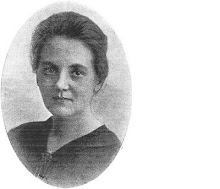

There was a poignant explanation for the particular joy that Anna Bøg took in watching the completion of the harvest as she returned to Siuyen by freight train in late August or early September, 1935:
The Manchurians often suffered from famine. Sometimes it was caused by flooding and other times by drought. The heavy rains that impeded Anna Bøg's departure on furlough in June, 1934 must have been the first of many such storms because by spring, 1935, there was famine and the poor starving people came to the missionaries in Siuyen for help. Although the missionaries had limited financial resources, they nevertheless decided to give a bowl of grain to everyone who came to them with a genuine need.
At first, the missionaries distributed the food to both the men and women together. By late May, however, they had divided the work so that Elise Bahnson and Mrs. Bjergaarde distributed food to the women and girls at the women's station while Rev. Bjergaarde provided for the men and boys at the adjacent men's station.
On June 4, 1935, Rev. Bjergaarde reported to the D.M.S., "Today we fed 230-250 persons. The number is growing day by day as we await the harvest that will bring new grain."
A few months later, on October 4, 1935, Rev. Bjergaarde wrote, "[T]he number of needy persons increased steadily as foodstuffs became entirely depleted in the countryside. . . . The women's yard was too small to accommodate all the needy women. It was a great relief when Miss Bahnson and my wife could move to the new schoolyard where a tent was set up to provide shade from the sun and protection from the rain like we had in the men's yard. Daily, we had about 800 men and 200 boys in our yard, while in the schoolyard there were 1,500 women, girls, and small children, mostly from the countryside [.]"
In the same article, Rev. Bjergaarde noted that in all they had distributed a total of 178,361 bowls of grain -- 114,823 to women and 63,538 to men. The types of grain used had included millet (the standard fare of Manchuria), beans, rice, and corn.
According to Rev. Bjergaarde, the total cost of the famine relief for the three months between June 8, and September 4, had been $4,376.19, of which $103.00 had been donated by the Chinese parish in Dairen, $87.18 had been from other Chinese friends, $2,217.26 had come from Denmark, and $1,968.75 had been donated by the Danish missionaries themselves. One missionary, Rev. Johannes Rasmussen, had donated $900.00.
In the annual report for the fiscal year 1935-1936, Elise Bahnson wrote, "With the rainy season, the misery grew among the poor ones and all our energy and strength were consumed. We could only resume our normal work after September 4th [1935]."
On October 16, 1935, Elise Bahnson wrote an article describing the work with the women during this difficult time. Here is her article in its entirety:
"They came to the gate and knocked -- the many poor people who were in distress this summer. And, as the Lord fed the multitudes, we were able to do the same this summer.Sources:
"Already the last week in May, they began to come.
"The new gate of the women's station was not as well known as the old gate of the men's station to the south, so it was some time before they found their way here.
"About the first of June, many came. We took turns being on watch for them and talking to those who came, many of whom were from afar and had never heard the Gospel. When approximately fifty had assembled, we distributed grain to them -- a large bowl for each woman and a smaller one for each child. Soon, however, we understood that it was difficult to control the situation so that some did not come back twice in one day.
"On June 5, we decided to be open from 1:00 p.m. to 2:00 p.m. The first day there were about 150 women and children. On June 8, it rose to 550, and June 13, to 800. We opened the gate about 1:00 p.m. and they came in, taking a place on the ground under a tent of matting that had been put up in the east yard as protection against the intense sun. We used the stone stairs of the gable of the women missionaries' residence as a speaker's platform. We sang, prayed, and talked for about a half an hour before the grain distribution began.
"We had been prevented from traveling to the countryside because of the bandit disturbances. Now the country people came to us. This time it was the poorest, who were driven by hunger to do so. But God is able to use all things, and we understood that a wonderful opportunity to sow the seed [of the Gospel] had been given to us.
"We did not attend the conference or leave for a summer vacation [this year], but I would not have had it any different. We saw clearly that the Lord had seen fit to block our passage.
"We began in faith and were not disappointed. Every day the Lord gave us what we needed for the day. One day, the grain was already used up while there remained many in the yard who had not yet received anything, but then we went to our own and our employees' households. And it happened not just once but many times that we had just what we needed for the day. Grain purchases were made every day.
"Rev. Olesen's old cook, who is now our cook, was a good source of support in that he had been in charge of grain purchases for the women's station. Some days we had to scrape the bottom of the money jar, but it turned out that just in time for the next day's purchase, we received additional funds.
"At the beginning, all the women and children came in at the women's station's north gate. Then one day the yard was filled to capacity with 800 women and children and I locked the gate. There were many who did not get in. I had no peace in my conscience that day. I believed that it was God's will that they should all have food. Then on June 15, we opened the inner yard, where women without children could gather, and then the clinic entrance and small yard where 250 children quickly came together. We sang and spoke at all three different locations every day. The [Chinese] Christian women came and helped us with oversight, etc. From that day onward, we began to distribute at the west gate (hospital entrance). Until the end, Mrs. Bjergaarde was my steadfast coworker, both at the [grain] distribution and as a speaker.
"Normally, the number of women and children was around 1,400. On July 1, it went over 2,000 but then fell again.
"Gradually, the women became friendlier toward us as well as quieter and more willing to listen, particularly those in the inner yard without children. It was for the most part the same people who came every day, but there were not a few who were only here a short time, then went home for a while, and then came back again later.
"Our Bible Women were not able to attend the meeting in Fenghwang this year but had to have their summer vacation here at home. They made good use of it. Old Mrs. Li (mother of the Bible Woman Miss Li at the hospital), Mrs. Liu-Yung-Hsi and Mrs. Liu-Kuei-Chen helped us to speak with the [famine victims]. During their summer vacation, we had both hospital Bible Women and students helping daily. Since school had ended, the woman and children were moved to the school grounds -- the new schoolyard located just west of the mission station. There was ample room. The tent of matting was moved and enlarged, and they sat on boards on the ground. We gathered the big children outside the large school playground to the east, but when it rained they came in to two large schoolrooms. Also when it rained the number was fewer.
"It was clear that all the small, malnourished children could not survive, and many died. Often the women came bearing tiny children such as you might say to yourself: Can they live through the day? They died on the street and they lay in rows on mats down by the river. Here, they do not bury children, but rather throw them out or cast them into the water.
"Each day, when we were at the end of the grain distribution, the mothers with sick children would come to the back where we gave them tickets for free medical treatment at the hospital. This last part of the work was the most difficult -- to witness all this suffering every day. We were happy to be able to refer them to the hospital. It was a relief where the need was the greatest. The suffering was so great that the women often could barely hear or take in [information].
"When the big cauldron that had daily cooked them a meal was taken out of use, they journeyed to their home district to gather grain in the field during the harvest. It was a great pleasure during the final days to feel their joy and gratitude for the help they had received.
"It was a mighty season of sowing [the Gospel]. When we are again permitted to go out into the countryside and meet them in their homes, we will learn how much they really took in, but the seed of the Word was sown, and God's word does not return void.
"In this way, I would like to bring the women's thanks further and to add our own. Thank you that we were able to accomplish this relief work.
"God is faithful, and faithful to his promises. I was again allowed to experience confirmation of the Word: 'Seek ye first the Kingdom of God and His righteousness, and all these things shall be added unto you.' [Matt.6:33.]
"Affectionate greetings,
"Your devoted envoy,
"Elise Bahnson"
Bahnson, Elise; "Giv Dem at Spise"; Dansk Missionsblad, Vol. 102, Nr. 49, 1935 (exact date unknown); pp. 757-759. Translated by Marie-Jacqueline.
Bahnson, Elise; "Frk. Bahnsons Beretning," D.M.S. Aarsberetning for 1935-1936, pp. 137-138. Translated by Preben Jørgensen.
Bjergaarde, Rev. Jens; "Hungersnød og Dyrtid i Siuyen"; Dansk Missionsblad, Vol. 102, Nr. 27, 1935 (exact date of issue unknown), pp. 413-414. Translated by Preben Jørgensen.
Bjergaarde, Rev. Jens; "Nodhjælpen i Siuyen," Dansk Missionsblad, Vol. 102, Nr. 45; 1935 (exact date of issue unknown); pp. 674-678. Translated by Preben Jørgensen.
Image:
Photograph of malnourished infant in Siuyen, from the article by Elise Bahnson, "Giv Dem at Spise," Dansk Missionsblad, Vol. 102, Nr. 49, 1935 (exact date unknown); p. 759.
All D.M.S. material used with permission.

