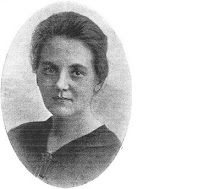
Showing posts with label BIBLE WOMEN. Show all posts

Tuesday, May 18, 2010

Faithful Friends in Dangerous Times (1943-1946)


As we will see in next week's post, Anna Bøg left the mission at Siuyen in May of 1946 under very tenuous circumstances. It took her and the other missionaries with whom she traveled several months to reach Denmark. A few months after her safe return to the D.M.S. headquarters in Hellerup, Anna Bøg described the last few years in Siuyen and the faithfulness of her Chinese friends this way:
"How intensely we were tied together, we Danes and the Chinese with whom we were allowed to share bad and hard times. As a rule Sunday midday and afternoon I visited my colleagues at the hospital and together we had a Danish service before parting. Thursday in the afternoon they dropped in at my place and every time it was a big problem to decide how to treat them: at the end I only managed to serve small cornbreads, maybe with a little salad made from home-dried raisins and walnuts, accompanied by a cup of black soybean coffee.

"I was the only Dane isolated at the mission station. The hospital is situated outside the town. Time and time again there were searches of the houses and interrogation. Our former great station had become so small. When the Japanese asked: How many of you are there? I answered with a smile: an old woman, a blind woman and a deaf girl. My smile should tell them that after all we were not dangerous. Those who in the world’s eyes were humble and mere nobodies, were faithful to me, friends never failing me in times of danger, always there to ward off the blows and never fearing for their own skin.

"It is indescribable what old Mrs. Kuo [Kuo-Chen-Yü], close to 70, baptized when she was 26, meant for the missionaries. Not only during the Boxer rebellion did she accompany the missionaries. During the many years she acted as Bible Woman, her sage and good counsel could always be followed. During the years of destruction she fetched for and accompanied us. And now during the last hours of distress she was faithful to me in all respects. She allowed me to take part in what she loved the most -- her son’s little daughter who every day was brought to me by her father to cheer me up on my lonesome post. (I was often amazed that he dared.) The last two years I also had to let my cook go. I myself had to be the cook, gardener and caretaker, but her son often offered me a helping hand.

"When the military police or the secret police all of a sudden stood at my door or in the courtyard, I said a silent prayer, ' Lord tell me what to say, help me to attest to God’s strength.' One learned to weigh one’s words. Often the Japanese wanted to move into the mission station or borrow the church for public meetings, but every time this was avoided with the help of God!

"Among the many different Japanese government officers I had to deal with, there were also some that showed friendliness, such as one who offered each of us a pound of sugar and some powdered milk.

"It was strange to have turned that poor, but the Chinese understood it. And how kind they were to me. They did not have much themselves but nevertheless offered me a piece of meat, some eggs, a little sugar or buckwheat and so forth. Last Christmas Eve [1945], Mr. Sung, the old chairman of our church council, came to see how I was getting along and to wish me a 'Merry Christmas '. When he departed, he left a red envelope* with 200 new bank notes. On January 31, [1946] he came again and this continued for six months. The last day of the month he came at 12:00 noon and every time he left 200. . . . The last time I saw him, when he came to say goodbye, he asked, 'Have you incurred debts? If so, I’ll take care of them.' I asked permission to pay him back what he had given me but he said, 'Certainly not.' This same Mr. Sung asked me to greet the home congregation and ask it to continue sending out missionaries as 'We absolutely cannot get by without them,' he said."
Sources:
Bøg Madsen, Anna; letter to the D.M.S. friends; December 5, 1946. From the D.M.S. archives in the Rigsarkivet. Courtesy of Kirsten Bergreen Buch. Translated by Preben Jørgensen.

Image:
Photograph of Anna Bøg and Mrs. Kuo (Kuo-Chen-Yü). The object that appears to be a cabinet is a Victrola. Courtesy of H.B. Petersen and Marilyn J. Madsen.
All D.M.S. items used with permission.
------------------------------
"red envelope" - In Chinese culture, the giver encloses a monetary
gift in a red envelope.

Tuesday, March 23, 2010

Teacher Wang's Home and the Christians at Sao-tzu-ho (Early 1939)


This week's post is a continuation of architect Elise Bahnson's account of the 16-day cycle tour she and two Bible women made in March, 1939, around the countryside south of Siuyen. Due to the travel restrictions, it was her first such trip in many years.

Elise Bahnson's description of the visit to Teacher Wang's home requires a little explanation. This was not the same Teacher Wang referred to in last week's post who was 89 years of age. This one was a Christian who had taught at the mission school for a time. Apparently his son, who was not a Christian, had recently married a Christian girl named Feng Ch'un who had lived at the women's mission station and worked in the mission Sunday School for many years. Her husband, Teacher Wang's son, was a postal employee in the area north of Siuyen, so the couple by then lived in the northern part of the district.

As for Sao-tzu-ho, our readers may remember previous mentions of the mission outstation there, such as in our post Invited Everywhere (1932) and the one about the pastoral visit that Rev. Ch'eng made to the Christians in that village when he was in Siuyen during October, 1936.
Teacher Wang's Home

"Up over a high mountain road we went, where there was the glorious view of the landscape. The road went past 'Front Mountain Village', up past a very fine new brick temple to the 'fox goddess', over a small ridge, and then we came into a large mountain village.

"[Teacher Wang's] oldest son is employed by the postal service to the north. He had been home for the wedding in the autumn. At that time, two of our Bible women were there to attend the young Christian bride, Feng Ch'un. When she was motherless and the only Christian in her home, she stayed with us and worked in the Sunday School for many years. Her father-in-law was a teacher in our school during the troubled years and had been baptized. The rest of the family had heard some [of the Gospel] here in town but they are still in the inquiring stage.

"Unfortunately, Feng Ch'un had just traveled northward, having visited us [in Siuyen] on her way. Up there, there is no congregation so she is the only one. [Her] young man is not a Christian, but he is willing to listen. In this home, one realizes that Feng Ch'un was a blessing to her mother-in-law and sister-in-law during the short time she was there.

"Teacher Wang is a very busy man, the inspector for seven schools in the area. He is the only Christian in the place. He said that he sorely lacked a Christian man in the vicinity to share with. Mrs. Wang is a busy housewife, so for her the evenings were the best. Then we sat on the kang and talked until late about the things of God's kingdom.

"Right beside the school lives Shu Ch'ing, a girl of eighteen years. During the turbulent years, she too lived in town and went to our school. She had also been at the hospital because of a bad foot. Finally, it was amputated and she received a wooden foot in its place. Recently, she had been to Mukden to a specialist and gotten a rubber foot. She could now walk freely without a cane, and stand a little on the leg. But best of all was that she had not forgotten what she had heard, either at school or during that half a year in the hospital. She prayed constantly and was aware to whom she belonged, and whom she would serve. How pleased she was to see us, and when she was invited over to the Wang family to stay as long as we were there, it was her joy to be together with us, touching us.

"We had the opportunity to talk both to the women from the neighboring homes and to the school girls, two and three times.

"We parted ways. The Bible Women went directly to Sao-tzu-ho. I cycled back to town [Suiyen] for a whole day in the city, and then went down to where they were in Sao-tzu-ho.

Sao-tzu-ho

"The River Yang meanders down towards the south from Siuyen and at its termination in Sao-tzu-ho (ho means River) lies the town of the same name: Sao-tzu-ho. The road to there runs along the other side of a ridge and over four high mountain ranges, four Danish miles.

"The Bible Women had come there from La-tzu-kuo, where we had parted. They had begun work on spreading the Gospel. Here in Siuyen we have an older couple who tend the church. They lived before in Sao-tzu-ho and took care of the chapel there. Now it has passed over to a younger brother. These two families, and Mr. Chang No. 4, were the only Christians when I was in Sao-tzu-ho seven years ago. [At that time] Mr. Chang No. 4 had just been released from his opium habit at a revival meeting in Nabo Town. His wife was a Christian, but far away from God because of his opium smoking. She had in her time been baptized at the hospital here. How completely different it is now.

"There is a congregation there of 64 Christians. It was truly a feast to meet with them and go around to their homes and get to know them in their surroundings.

"We had to go out to see the new lot with a three-room house that the congregation has recently purchased. When I went and looked at it, Mr. Chang No. 4 came along and told me how they had imagined it: they would now build four rooms that could be used as church halls. Later, when they could build a large church, this could be used to feed the Christians who came in from more distant places.

" [']We have a stonemason, a builder and a carpenter in the congregation and when we have finished sowing [our crops] we will start work. Then you will have to come down and see us and give us good advice.['] Later, he told me, 'Yes, when I've got everything in order, I can depart in peace.'

"I could not help but compare this visit to his home to the first time. Now the spirit in the home was quite different. All three sons and two daughters-in-law were Christians, together with their children. The oldest daughter-in-law's mother also lived there on the farm and had recently been baptized. I was permitted to teach his grandson's wife and daughter.

"In the village where Mrs. Wang, an assistant in our work, is from, I looked in at four different Christian homes.

"Across the other side of the River Yang, we went to the home of an 82-year-old Christian woman who was severely ill and fighting to live. We were allowed to sing to her and talk and pray with her. Two days later we heard that the Lord had taken her. Now her son was the only Christian left in the village.

"Not very far from there in a small village we went in the three Christian homes where there are in all ten Christians. Liu Ch'ing Wen and his brother, who is a carpenter, had built the houses himself. They were very new and not quite finished. On account of the bandits, they had been forced to move out of the mountain valley they had lived in.

"Over a high mountain in a completely different direction, I was in two Christian homes. On the way there, I saw a house I had visited when I first went down there. Very few of the walls were standing. The house had been completely demolished. During those years, all who lived near one of the mountains or in between the mountains had moved out of their villages.

"In the village that was now our goal, there was a Christian home. A daughter from the home is a [nursing] student at the hospital here. Her parents and grandmother are Christians. The old grandmother, who is 80 years old, lay on the kang. Her hearing is bad and it was hard for me to communicate with her. It is difficult for a woman so old to understand a foreigner, especially when her hearing is not so good. Another Christian daughter was home visiting and they have a Christian son and daughter-in-law in Dairen. In that home, the oldest Christian was the husband. One could feel it.

"On the way back, we visited another home with three Christians -- the husband and his parents. The old man was over 70 years. He could not get around but sat on the kang. His wife was a good deal younger. She got off the kang and sat to the side so that we could pray together.

"During one of the other trips and during this last trip, a church woman from Siuyen came with me. We had an opportunity to talk about the difference. I said to her, 'The old woman in this last home, she was a light. How is it with you?' She replied, 'I have for many years not taken my Christianity seriously, but now it is entirely different. I came down here to my old neighborhood because I wanted to follow you around and quietly do a little work for the Lord.'

". . . Now I have been on this little rush tour and seen a little of the inside of these Christians' homes. Then there is even a large group in a home where the son is an evangelist. They live on the other side of the Sao-tzu-ho River. I did not reach there. But is it not wonderful what the Lord has done during these years? They were feast days when I was allowed to speak to them and visit them."
Sources:
Bahnson, Elise; "Endelig paa Landtur igen"; Dansk Missionsblad; Vol. 106, Nr. 17, April 26, 1939; pp. 249-252. Translation by Marie-Jacqueline.
Bahnson, Elise; "Besøg i Sao-tzu-ho", Dansk Missionsblad; Vol. 106, Nr. 20, May 17, 1939; pp. 292-293. Translation by Marie-Jacqueline.

Image:
Teacher Wang and Family (1939), from the first article cited above.
All D.M.S. items used with permission.

Tuesday, March 16, 2010

The Round Mountain Village and the Fox Goddess Cult (Early 1939)


By the 1930s, the city of Siuyen had a population of about 20,000, although there were fluctuations during the famine and the bandit attacks when people came into town by the thousands. The entire Siuyen mission district was comprised of about 3,500 square kilometers of land and had about 180,000 inhabitants.

The travel restrictions referred to in our earlier posts such as Landlocked (Early 1936) were not self-imposed or imposed by the D.M.S. Rather, the Manchukuo government imposed them and the police enforced them. Although by mid-1936 the new motor coach line had made it possible to travel via bus to other towns and to reach the passenger railroad line, the kind of missionary journey to outlying villages described in our post Invited Everywhere (1932) had not been possible for many years.

In early 1939, however, Elise Bahnson, Anna Bøg's collaborator in the work with the women in Suiyen, received governmental permission to make just such a trip in the company of two Bible Women.

Here is Elise Bahnson's account:
"There came the first authorization for foreigners to travel in the country in Siuyen District. None of us had thought it would come so quickly.

"In the month of January there was a big hunt for the bandits to get them rooted out. The result was that the two remaining bandit chieftains along with their some twenty cohorts were either captured or surrendered. It was said in town that there were no more bandits in the District.

"When we held the co-workers' meeting on February 27, the Christian Mrs. Chao came from the 'Round Mountain Village' to invite us out there. The last beating of the bushes to find the bandits had been a very difficult passage. Everyone in the village made offerings to the fox goddess to obtain help. The fox goddess is very much worshipped in Siuyen and its environs. But Mrs. Chao stood firm and would not.

"When the push [for the bandits] was over, and there had been a good outcome, the village people said, 'That woman has something to hold onto'. They came and wanted to hear. Before they had not wanted to listen.

"Since that place was also the native village of the Bible Woman, Miss Chao, we thought there was every reason to go there right away. Our minister, who handles most of the police matters, thought I would receive permission. I too had high hopes. The Bible Woman and I went in and came back beaming, with authorization for a 16-day tour in the country. It was as if a new page had been turned, that we really had permission to move freely in the country.

"Cycling Tour

"The first of March, two Bible Women and I left on our bicycles by way of the Takushan Road. Our things came after us on a little pushcart. They may be driven on the highway, as they have motorbike wheels, so these days there are many of them.

"[We traveled] approximately one and a half Danish miles out along the main road over two [mountain] passes. Below the last was a side road that went alongside a little stream into a valley. This road was not as good as the main highway, with only bridges over the streams in a few places.

"I felt almost as if I had not been in this country all these years because we have not been able to go outside of town. It was almost like being released from prison -- wonderfully glorious.

"In four and a half hours' time, we reached the village. During the last stretch, the road ran out. There were only paths, as usual everywhere before in the old days. There we had to walk our bicycles.

"The Round Mountain Village

"South of a bend in the River Yang is 'The Round Mountain'. The valley goes completely around it on all sides in a circle, and the mountain is quite low. South of the mountain, the village lies midway between a collection of villages.

"This time we did not visit all the villages. Some nine years ago, the Bible Woman Miss Chao's family moved into town, and during those nine years the daughter had not been home. Now she came with light and ardor to give her kinsmen the Gospel and the Savior she herself had come to love and serve.

"It was a joy to follow her on her first country visit in the district to her own native place. Her aunt and uncle were our hosts. They inhabit a 5-room house with side houses. The grounds are divided in two by an invisible center line. The eastern part belongs to her uncle. The west was her old home, now rented to a relative. Her aunts and uncles had also lived in town, had heard the Gospel, and had been baptized. They were now out to invite people to our meeting.

"From the first evening, the kangs were full of women and children, the chests and tables of boys, and the benches of men. So it was every evening during the five evenings we were there. Many heard the Gospel proclaimed for the first time.

"The first day we were out on house visits, an old woman, a zealous Buddhist, was visited. She did not come [to the meetings] the first few days but the last two evenings she came. She wanted to hear her young relative speak. She was not unaffected. She had otherwise said to her sons that those who wanted to be Christians would be disinherited. One of her sons had decided he wanted to be a Christian, he and his house.

"The next day we went on a visit to the 'Mountain Village Behind', a larger village. We went to the home of the Shih family. The 70-year-old woman was born a Chao. The [home had] two wide kangs and two large rooms. The rooms were soon full. There were several who had never heard the Gospel.

"In the audience was a man who made his living as a soothsayer and with continual satanic power misled the local people. That sort is called 'Ta Shen', which is directly translated as 'the great God'. He is gone for and questioned when there is illness, death, or other difficulties.

"He said right out, while the others heard it, 'I know mine is fake -- that is true. I will wait until after the 15th [in the Chinese calendar]. (That day is an important day of offering to the idols.) 'If you believe, then we will follow,' said several. Poor thing! He was trapped. Soon thereafter one of his assistants came and got him as there was no one at his home who sought him.

"A small cluster of houses stood alone. We went in. A schoolteacher came along with the children, and in a moment there was again a great assembly to speak to.

"The evening before the 15th, the Bible Women talked about how at Ephesus they had burned the costly sorcery books.

"That evening, some boys said to their father that they wanted to be Christian. 'Shall we take the idols down?' That evening they did not come down, but neither was there a sacrifice to them in the morning.

"We heard about a second home where the man had taken down the idols. As we talked about it, the woman went over and tore down the god of wealth. He had been glued to the wall right behind me. The man took down the threshold god, and to get [the home] entirely clean, the Bible Woman took down the kitchen god. 'It gives me particular pleasure,' she said, 'to help clean out the rooms where we lived, my old home.

"There was a bundle of joss stocks that the man had recently purchased. It was a little hard to get them under the pot, but they got them there and they were also burned.

"On Sunday (the 15th), the Bible Woman came and said, 'May I go over to my old teacher in the village near here? I have been repeatedly reminded of my old Teacher Wang, now 89 years old. I must go over and see him.' Then she went with a relative and came back radiant. 'As soon as I told him about the true God and Jesus, he was ready to believe. He has now decided that he wants to be a Christian.'

"The next day when we left, I went there to greet him. He was quite clear of mind, could still read, and did so wonderfully. We left a few books and promised him a Bible. He is very poor and alone. His family has relocated to other districts."
There will be more about this trip in next week's post.

Source:
Bahnson, Elise; "Endelig paa Landtur igen"; Dansk Missionsblad; Vol. 106, Nr. 17, April 26, 1939; pp. 249-252. Translation by Marie-Jacqueline.

Image:
Chao home in Round Mountain Village, from the article cited above.
All D.M.S. items used with permission.

Monday, February 22, 2010

The Nielsens Return; Reverend Ch'eng Visits (Late 1936)


In an article published in the Danish missionary newspaper in late 1936, Anna Bøg related that the long-anticipated government-sponsored long-distance motor coach line had finally opened. It connected Siuyen with Ta-shih-chiao [Dashiqiao], a stop on the main line of the South Manchurian Railway 25 kilometers southwest of Haicheng (the closest passenger station to Siuyen). As a result, the missionaries in Siuyen were no longer as isolated as we described in our post Landlocked (Early 1936).

Missionaries from other locations in Manchuria had taken the new bus to Siuyen and some of the missionaries had by then discovered Sorai Beach in Korea as a vacation spot. Although they now had the means to join them, Anna Bøg and Elise Bahnson had concluded it was God's will for them to remain in Siuyen that year.

The high points of the latter part of the year had both occurred in October. Dr. and Mrs. Nielsen had returned to Siuyen after the three-year furlough that followed Dr. Nielsen's release from captivity by the bandits. And, Reverend Ch'eng Chan Yuan, a Lutheran minister ordained in 1934, had traveled by bicycle to Siuyen all the way from Lin-chiang, northeast of Siuyen on the Manchurian side of the Yalu River that divides Manchuria from Korea:
"It was a great joy when the new bus route opened July 2 between Ta-shih-ch'iao and Siuyen. It is a stretch of 150 kilometers. There are eight villages along the route where the bus stops. It costs five cents per kilometer and $5.25 for the entire trip. Those who have tried it are all very excited about the wonderful nature scenery, especially about one of the mountain passes, which is very beautiful. Now we no longer feel as confined as we have during recent years.

"Miss Bahnson and I talked about also trying out the route and taking off for summer holidays to be with our colleagues at the beautiful beach in Korea. We prayed for God's guidance and saw several reasons why we should stay home. The same day we made that decision, we, together with all our co-workers, the evangelists and Bible Women, began to study Japanese with a very nice young Manchurian as a teacher. He is an interpreter. We studied five times a week.

"Several times, our co-workers wanted to give up as they were not accustomed to studying languages other than their own, but now they have come so far as to enjoy it. Some of them are really adept. And we find it very amusing when we get visits [from Japanese officials] because we can understand a little of what they say.

"One afternoon a senior official was here on a visit. As it was approaching the time when we were going to study, I asked him if he wanted to teach us. 'Yes,' he was more than willing. Another day, the dean of the Japanese school listened to us and corrected us. The same young man has come to our worship service several times and on Sunday morning comes into my Bible class to sing for the women.

"The Manchurians have been able to come and go, but for several years no missionaries have visited here. Rev. Witt was the first to try the bus route. . . . After that, Miss Bech-Andersen was here. And now it is ten days since we had the very great pleasure of welcoming Dr. and Mrs. Nielsen home. We were eating our midday meal when old Yang stuck his head in the door and said, 'Dr. Nielsen has arrived!' We got up from the table, got on our bicycles, and minutes later were at the bus station where the two oldsters, as we call them here, were standing happy and excited among all the suitcases. The news traveled rapidly all over town, and a group of Christians was on the way over to welcome them home. It was exactly three years previously that Dr. Nielsen came home from the mountains, and almost three years since they left Siuyen. In God's time, doors open and what God unlocks, no one can lock in.

"At the same time, we were also visited by the young Reverend Ch'eng from Lin-chiang. It had been about two and a half years since we'd had a visit from any outside minister and we had not expected that he would be the first to come. We had received a card, "Reverend Ch'eng will come the 15th of October," but not from where he would come, or how he could come. The evangelists arrived by bus, but no minister. A little later, he came by bicycle from Takushan. He had cycled the entire way from Lin-chiang to Siuyen, approximately 67 Danish miles, on unlevel roads through mountain passes and across rivers, sometimes in Korea and sometimes on the Manchurian side, stopping at outstations and Christian homes along the way and the entire time testifying about his Master and Lord. Spontaneously, people said, 'I wish there were many like Reverend Ch'eng.' . . .

"Reverend Ch'eng immediately put himself at our service. 'I will work for you all, so you can rest a little,' he said. He was with us for ten days, held seventeen meetings, two large Communion services, a baptism, and a wedding. One morning, he cycled out to Hsing-lung-kuo, where he spoke to the Christians. The last two days he was at the hospital, where he held four meetings and took old Mrs. Fu to Communion.

"We had meetings for the women every morning and for the men every afternoon. For reasons of space, we limited our invitations to the Christians and catechumens. Every morning, we were overcrowded, so we put extra benches out in the sunny yard and with the windows open one could hear well. He was used by the Lord for blessing. He clarified many issues that we all have to face in these uncertain times. Some of the catechumens received so much help that they were very sad when the meetings were over and we could no longer keep the minister here.

"One day he asked about the outstations and we understood that the minister was also willing to travel to the only place open in our district in these times, Shao-tzu-ho. When a Christian from there, Mr. Liu, who had come here to attend the meetings, heard this, he immediately went back to tell the Christians about this unexpected joy. They are all rural residents and had to arrange their work so they could attend. Tuesday a small cart drove off with two men and two Bible Women. Most of the approximately four Danish miles of the road [to Shao-tzu-ho] consist of four long mountain passes. Wednesday morning, Reverend Ch'eng and evangelist Chang left by bicycle.

"They had four days of meetings with Communion services. We were very pleased about the glorious autumn weather, which helped everyone to attend. Also, we were glad that all the Christians could assemble in their own little outstation for Communion. It has been many years since they could do that. All those who were baptized from Shao-Tzu-ho last Christmas and Pentecost said, 'We are the fruit of Mr. Liu'. . . How glad we were when this little band came at Pentecost and asked for baptism.

"Here at home in Siuyen we are all very busy. There are 63 women on the catechumens' list and 25 schoolgirls. With all the weekly Bible studies, devotions, prayer meetings, Sunday school and home visits, we can say that we are fully occupied.

"And in all circumstances, we can attest to experiencing Jesus' promise, 'Behold, I am with you all days.' "
Source for article:
Bøg-Madsen, Anna; "Siuyen," Dansk Missionsblad, Vol. 103, No. 50, 1936 (exact date unknown), pp. 741-744. Translation by Marie-Jacqueline.

Source for additional information regarding Rev. Ch'eng:
Jensen, Anne Hviid; I Lys Og Skygge (Unitas Forlag, Copenhagen, 2005), p. 111.

Image:
Photograph of Rev. Ch'eng during his 1936 visit to Siuyen, from Bøg-Madsen, Anna; "Smaabreve fra Siuyen, Bogsælgeren," Dansk Missionsblad, Vol. 104, No. 9, 1937 (exact date unknown); p. 128.
All D.M.S. items used with permission.

Monday, February 15, 2010

Landlocked (Early 1936)


In 1936, the editor of the D.M.S. missionary newspaper wrote, "The way out from Siuyen seems still not passable, so none of the Siuyen missionaries have been out on vacation in the last few years."

It was not just that the Siuyen missionaries were not able to take vacations, however, but that they were basically imprisoned in Siuyen because of the bandit activity. Thus, neither Anna Bøg nor Elise Bahnson was able to make the kind of missionary journey to outlying areas described in our post Invited Everywhere (1932).

Nevertheless, Anna Bøg and Elise Bahnson carried on their work within the city limits of Siuyen, making home visits, teaching catechumens, giving Bible courses, leading prayer circles, organizing and presenting New Year's meetings, and participating in devotions at Siuyen Hospital. Both were also active in the Sunday School, which had a large attendance.

In a 1935 publication, the Y.W.C.A. said about Anna Bøg and Elise Bahnson, “Young, clever and warm-hearted collaborators, they are a good support for the work done among women and children.” They were also a good support for one another. In late February, 1936, Anna Bøg wrote, "It is good that we are two during this very difficult, tense time."

Anna Bøg related that besides being unable to travel they had been oppressed by cold and illness. "The entire month of January was very cold. There was hardly any snow. Despite the extreme cold, we had sunshine every day. Much illness followed. At our house, Miss Bahnson was ill with a high fever, influenza. She got better twice but then relapsed, and she was very tired when she began to recover."

Because of the travel restrictions, Elise Bahnson was not able to bring her architectural skills to the other missions where they were needed. Her design skills did not entirely lie dormant, however. Dr. and Mrs. Bertelsen wrote, "The congregation here has received a baldachin designed by Miss Bahnson -- it is very beautiful. . . . Earlier the pagans frequently said, "We don't understand you Christians; you do not do anything for your deceased!" But even the pagans say that the baldachin is beautiful." (The baldachin was an ornamental canopy to be used in funerals.)

In the February, 1936 account, Anna Bøg described the recent activities at the women's station, which we summarize here:
During Chinese New Year, they held a week long Bible course for the Christian women and catechumens, along with special meetings for the children. In spite of the very cold weather, there was a full house every day. Although the Chinese ate special meals during the New Year's celebrations, there were only two such meals and so the Chinese women were nevertheless able attend the Bible course. It was held from 10:00 a.m. to 1:00 p.m. daily, not counting recreational time.

There were fifteen local speakers plus two young male evangelists who had just graduated from the evangelist school and brought a breath of fresh air from the outside. The women read John's letters, Jesus' parables, practiced new songs, and heard and saw special New Year's texts and pictures.

On the last day, several women attested to the deeper conversion they had experienced as a result of the meetings. One woman said, "The image of the snake that winds about people and holds them, has spoken to me about that sin that binds me." Another intended to go home and speak to the brother-in-law who lived on the same farm but whom she had not spoken to for a year.

About 30 children participated and the children were observed to pray very devoutly. At the end of the meetings both the women and the children asked, "Isn't there more?"

The missionaries and Bible women had planned meetings for the pagan women that were to take place the following week but shortly before the meetings something occurred that upset the pagan woman and as a result the attendance was less than had been anticipated.

Currently, many women were attending the Bible studies on Friday afternoons and about 50 were being prepared for baptism.
In the D.M.S. Annual Report for the fiscal year 1935-1936, Anna Bøg noted, "For the weekly work, we have three devotions in school, one to two devotions in the hospital, three Bible classes in town, and ten prayer groups. On the catechumens list, including both adults and youth, in the fall we had 110. Most were studying twice a week. There were countless visits in homes, intensive work among the pagans, Sunday school work, and so forth."

And, even though the missionaries could not leave town, the Bible Women could. In the article written in late February 1936 summarized above, Anna Bøg related, "Our nice young Bible Women who have learned to cycle, have been out to several villages and held meetings. We Danes cannot leave town [but] we hear about places where it is peaceful, and then they cycle there."

In the same annual report for 1935-1936, Elise Bahnson wrote about the specifics of the work in the outlying areas, apparently all of it accomplished by the Bible Women:
"Hsing-lung-kou was visited twice a week in the spring. The young Bible Women had a baptism class there. Before the six woman and six children were baptized, they came here for a short time for education. A young girl from there was confirmed.

Shao-tzu-ho was visited twice and two women were baptized at Christmas.

Lohr-chüan-kou - From the Pang's home, daughter-in-law No. 4, a widow with a small son, was baptized. They are now in Antung in the children's home. Daughter-in-law No. 1, also a widow, had her daughter-in-law baptised.

Su-Tzu-kuo - From the Li home, a young girl was confirmed and shortly after that she went back to the pagan home that she had been given to as a small child.

Chien-shan-yao - The Christian Mrs. Shen brought her adult daughter in for education. As many in the countryside, she had for some time been under Tao-te-hui's influence.* [In that religion] after a year of study, young girls can proclaim the teaching and earn their living. This tempts many young persons."
Sources:
Bahnson, Elise; "Frk. Bahnsons Beretning," D.M.S. Aarsberetning for 1935-1936, pp. 137-138.
Bertelsen, Peter and Dorthe; "Hospitalet i Siuyen," Dansk Missionsblad, Vol. 103, Nr. 49, 1936 (exact date unknown).
Bøg-Madsen, Anna; "Siuyen," Dansk Missionsblad, Vol. 103, No. 16, April 15, 1936, pp. 230-232.
Bøg-Madsen, Anna; "Frk. Bøg Madsen skriver," D.M.S. Aarsberetning for 1935-1936, pp. 136-137.
"Fra Redaktionen", Dansk Missionsblad, Vol. 103, Nr. 26, 1936 (exact date unknown).
Young Women's Christian Association; Vest-Øst, 1910-1935, (Kristelig Forening for Unge Kvinder, 1935), p. 64.
All D.M.S. items used with permission.

Image:
Photograph of Elise Bahnson (left) and Anna Bøg in front of the old women missionary's residence in Siuyen, May, 1931. Courtesy of H.B. Petersen.
-----------------------------
*This was not the only reference to the influence of Tao-te-hui during this period. Dr. Bertelsen also mentioned it in the 1936 article quoted above when he wrote about the baldachin designed by Elise Bahnson.

Tuesday, January 19, 2010

Feeding the Multitudes (Elise Bahnson, 1935)


There was a poignant explanation for the particular joy that Anna Bøg took in watching the completion of the harvest as she returned to Siuyen by freight train in late August or early September, 1935:

The Manchurians often suffered from famine. Sometimes it was caused by flooding and other times by drought. The heavy rains that impeded Anna Bøg's departure on furlough in June, 1934 must have been the first of many such storms because by spring, 1935, there was famine and the poor starving people came to the missionaries in Siuyen for help. Although the missionaries had limited financial resources, they nevertheless decided to give a bowl of grain to everyone who came to them with a genuine need.

At first, the missionaries distributed the food to both the men and women together. By late May, however, they had divided the work so that Elise Bahnson and Mrs. Bjergaarde distributed food to the women and girls at the women's station while Rev. Bjergaarde provided for the men and boys at the adjacent men's station.

On June 4, 1935, Rev. Bjergaarde reported to the D.M.S., "Today we fed 230-250 persons. The number is growing day by day as we await the harvest that will bring new grain."

A few months later, on October 4, 1935, Rev. Bjergaarde wrote, "[T]he number of needy persons increased steadily as foodstuffs became entirely depleted in the countryside. . . . The women's yard was too small to accommodate all the needy women. It was a great relief when Miss Bahnson and my wife could move to the new schoolyard where a tent was set up to provide shade from the sun and protection from the rain like we had in the men's yard. Daily, we had about 800 men and 200 boys in our yard, while in the schoolyard there were 1,500 women, girls, and small children, mostly from the countryside [.]"

In the same article, Rev. Bjergaarde noted that in all they had distributed a total of 178,361 bowls of grain -- 114,823 to women and 63,538 to men. The types of grain used had included millet (the standard fare of Manchuria), beans, rice, and corn.

According to Rev. Bjergaarde, the total cost of the famine relief for the three months between June 8, and September 4, had been $4,376.19, of which $103.00 had been donated by the Chinese parish in Dairen, $87.18 had been from other Chinese friends, $2,217.26 had come from Denmark, and $1,968.75 had been donated by the Danish missionaries themselves. One missionary, Rev. Johannes Rasmussen, had donated $900.00.

In the annual report for the fiscal year 1935-1936, Elise Bahnson wrote, "With the rainy season, the misery grew among the poor ones and all our energy and strength were consumed. We could only resume our normal work after September 4th [1935]."

On October 16, 1935, Elise Bahnson wrote an article describing the work with the women during this difficult time. Here is her article in its entirety:
"They came to the gate and knocked -- the many poor people who were in distress this summer. And, as the Lord fed the multitudes, we were able to do the same this summer.

"Already the last week in May, they began to come.

"The new gate of the women's station was not as well known as the old gate of the men's station to the south, so it was some time before they found their way here.

"About the first of June, many came. We took turns being on watch for them and talking to those who came, many of whom were from afar and had never heard the Gospel. When approximately fifty had assembled, we distributed grain to them -- a large bowl for each woman and a smaller one for each child. Soon, however, we understood that it was difficult to control the situation so that some did not come back twice in one day.

"On June 5, we decided to be open from 1:00 p.m. to 2:00 p.m. The first day there were about 150 women and children. On June 8, it rose to 550, and June 13, to 800. We opened the gate about 1:00 p.m. and they came in, taking a place on the ground under a tent of matting that had been put up in the east yard as protection against the intense sun. We used the stone stairs of the gable of the women missionaries' residence as a speaker's platform. We sang, prayed, and talked for about a half an hour before the grain distribution began.

"We had been prevented from traveling to the countryside because of the bandit disturbances. Now the country people came to us. This time it was the poorest, who were driven by hunger to do so. But God is able to use all things, and we understood that a wonderful opportunity to sow the seed [of the Gospel] had been given to us.

"We did not attend the conference or leave for a summer vacation [this year], but I would not have had it any different. We saw clearly that the Lord had seen fit to block our passage.

"We began in faith and were not disappointed. Every day the Lord gave us what we needed for the day. One day, the grain was already used up while there remained many in the yard who had not yet received anything, but then we went to our own and our employees' households. And it happened not just once but many times that we had just what we needed for the day. Grain purchases were made every day.

"Rev. Olesen's old cook, who is now our cook, was a good source of support in that he had been in charge of grain purchases for the women's station. Some days we had to scrape the bottom of the money jar, but it turned out that just in time for the next day's purchase, we received additional funds.

"At the beginning, all the women and children came in at the women's station's north gate. Then one day the yard was filled to capacity with 800 women and children and I locked the gate. There were many who did not get in. I had no peace in my conscience that day. I believed that it was God's will that they should all have food. Then on June 15, we opened the inner yard, where women without children could gather, and then the clinic entrance and small yard where 250 children quickly came together. We sang and spoke at all three different locations every day. The [Chinese] Christian women came and helped us with oversight, etc. From that day onward, we began to distribute at the west gate (hospital entrance). Until the end, Mrs. Bjergaarde was my steadfast coworker, both at the [grain] distribution and as a speaker.

"Normally, the number of women and children was around 1,400. On July 1, it went over 2,000 but then fell again.

"Gradually, the women became friendlier toward us as well as quieter and more willing to listen, particularly those in the inner yard without children. It was for the most part the same people who came every day, but there were not a few who were only here a short time, then went home for a while, and then came back again later.

"Our Bible Women were not able to attend the meeting in Fenghwang this year but had to have their summer vacation here at home. They made good use of it. Old Mrs. Li (mother of the Bible Woman Miss Li at the hospital), Mrs. Liu-Yung-Hsi and Mrs. Liu-Kuei-Chen helped us to speak with the [famine victims]. During their summer vacation, we had both hospital Bible Women and students helping daily. Since school had ended, the woman and children were moved to the school grounds -- the new schoolyard located just west of the mission station. There was ample room. The tent of matting was moved and enlarged, and they sat on boards on the ground. We gathered the big children outside the large school playground to the east, but when it rained they came in to two large schoolrooms. Also when it rained the number was fewer.

"It was clear that all the small, malnourished children could not survive, and many died. Often the women came bearing tiny children such as you might say to yourself: Can they live through the day? They died on the street and they lay in rows on mats down by the river. Here, they do not bury children, but rather throw them out or cast them into the water.

"Each day, when we were at the end of the grain distribution, the mothers with sick children would come to the back where we gave them tickets for free medical treatment at the hospital. This last part of the work was the most difficult -- to witness all this suffering every day. We were happy to be able to refer them to the hospital. It was a relief where the need was the greatest. The suffering was so great that the women often could barely hear or take in [information].

"When the big cauldron that had daily cooked them a meal was taken out of use, they journeyed to their home district to gather grain in the field during the harvest. It was a great pleasure during the final days to feel their joy and gratitude for the help they had received.

"It was a mighty season of sowing [the Gospel]. When we are again permitted to go out into the countryside and meet them in their homes, we will learn how much they really took in, but the seed of the Word was sown, and God's word does not return void.

"In this way, I would like to bring the women's thanks further and to add our own. Thank you that we were able to accomplish this relief work.

"God is faithful, and faithful to his promises. I was again allowed to experience confirmation of the Word: 'Seek ye first the Kingdom of God and His righteousness, and all these things shall be added unto you.' [Matt.6:33.]

"Affectionate greetings,

"Your devoted envoy,

"Elise Bahnson"
Sources:
Bahnson, Elise; "Giv Dem at Spise"; Dansk Missionsblad, Vol. 102, Nr. 49, 1935 (exact date unknown); pp. 757-759. Translated by Marie-Jacqueline.
Bahnson, Elise; "Frk. Bahnsons Beretning," D.M.S. Aarsberetning for 1935-1936, pp. 137-138. Translated by Preben Jørgensen.
Bjergaarde, Rev. Jens; "Hungersnød og Dyrtid i Siuyen"; Dansk Missionsblad, Vol. 102, Nr. 27, 1935 (exact date of issue unknown), pp. 413-414. Translated by Preben Jørgensen.
Bjergaarde, Rev. Jens; "Nodhjælpen i Siuyen," Dansk Missionsblad, Vol. 102, Nr. 45; 1935 (exact date of issue unknown); pp. 674-678. Translated by Preben Jørgensen.

Image:
Photograph of malnourished infant in Siuyen, from the article by Elise Bahnson, "Giv Dem at Spise," Dansk Missionsblad, Vol. 102, Nr. 49, 1935 (exact date unknown); p. 759.
All D.M.S. material used with permission.

Tuesday, January 12, 2010

Hidden by the Angels (1934-1935)


Anna Bøg's second furlough was from June, 1934, to August, 1935. Anna Bøg traveled by boat from Dairen in Manchuria to Kobe, Japan, and from there by ship to San Francisco for a stay in America. After that she left by ship from New York for Denmark and after some time there departed from Copenhagen by ship for Manchuria.

Unfortunately, this furlough was beset by difficulties -- not in America or Denmark but rather in leaving from and returning to Siuyen. First, turbulent weather threatened to impede her departure. In June, 1934, Rev. Bjergaarde reported:
“Miss Bøg Madsen was . . . scheduled to leave on June 8 by boat from Dairen to Japan and had hoped to leave here by automobile on Thursday, May 31 but this was hindered by an extraordinarily strong rain causing turbulence in the rivers, making it impossible for an automobile to cross without the risk of being pulled into the violent current. There are no bridges. To obtain a military escort and a Chinese cart would not be easy …Someone even thought of telegraphing to get a plane to pick up Miss Bøg Madsen. Well, that’s the way it is when one is at an inland station. It is no problem to travel around the world if one can manage the 90 kilometers to the railroad station. On Monday, June 4, however, the automobile was able to navigate and she caught the ship in Dairen on time.”
During this second furlough in 1934 and 1935, Anna Bøg spent time with her family on the West Coast and in Iowa. Family members remember this visit with affection. For instance, Anna Bøg's brother Peter's son Stanley tells an anecdote about Anna Bøg's visit to the family farm in Oregon. Anna Bøg wanted to go in to the nearest town. Peter offered to drive her but she did not wish to go by automobile and instead insisted on walking. Peter then sent young Stanley to accompany her, whereupon Anna Bøg (then nearly 47 years of age) set off walking at a pace so fast that Stanley was impressed.

After her stays in America and Denmark, Anna Bøg returned to Manchuria in August, 1935 aboard the Italian steamer the Conte Rosso in the company of the Rev. Buch family and other missionaries. The Buchs could go from Dairen by train directly to their post in Harbin but for Anna Bøg her return to Siuyen was even more difficult than her departure had been. Our readers will recall that there was no passenger train to Siuyen, the nearest passenger station being Haicheng. Moreover, there was still a major risk of being attacked or taken hostage by the ever-present bandits. This was especially the case since at the time the tall crops had not yet been fully harvested. As ever, they provided good cover for the bandits. And, the memory of Dr. Nielsen's long captivity was still fresh in everyone's minds.

Here is Anna Bøg's account of her return:
“A month to the day after my departure from Copenhagen, I landed with my fellow passengers in Dairen, where a letter from Siuyen informed me not to attempt the trip to Siuyen until the harvest was over. Three weeks later, a letter arrived saying that the harvest was now advanced to the point where I could try to come. I went to Haicheng, which was the closest railway station to Siuyen. There I was kindly received by the British missionary, Miss Macintyre, and went with her to the authorities. There I was also kindly received and informed that I could travel by an automobile that was leaving the next day from another station. After thinking it over, I concluded that the automobile was for soldiers, and that I had better go by horse and cart even if it was dangerous. In the meantime, I received a message from Siuyen asking me to wait a couple of days because the Bible Woman, Mrs. Kuo, had left for Haicheng in a freight train.

"[On Mrs. Kuo's arrival,] I learned that at times the freight cars had become stuck in the mud. Mrs. Kuo’s freight car had overturned and thrown her into the mire. Mrs. Kuo brought me my old coat and blanket. She dared not suggest that I return with her. I was at a loss about what to do and wondered if it could be God’s will for me to go with her. If things went awry, not only I but also the missionaries in Siuyen could suffer consequences. I continued praying, 'Turn your path to the Lord and he shall rescue you.' The next morning I still had no light but then I read in Job 5: 19-27, 'He shall deliver thee in six troubles: yea, in seven there shall no evil touch thee. … And thou shalt know that thy tabernacle shall be in peace; and thou shalt visit thy habitation …'.

“When I pondered over these words I thought that this was the Lord’s answer to me, and when Mrs. Kuo came to tell me that the train was leaving at 12:00 and she was going with it, the only answer was, 'I will also go.' Mrs. Kuo arranged everything for the trip and had my belongings carefully put away in old sacks, so no one could see what they contained. Then we left with the freight train for Siuyen. My heart was in the beginning uneasy and fearful, especially about the consequences for the D.M.S., but the Word continued sounding, ‘In six anxieties and in seven.’

“The next day, after having been to an inn, the anxiety had disappeared. We passed several villages with me covering my head with my blanket so nobody could see who I was. But all of this would have been of no use if the angels hadn’t hidden me. I sat quietly and enjoyed the trip, seeing the farmers driving the sheaves home to be threshed, and the women gathering cotton in the field or harvesting rice with bowed knives.

“We had several delays, but later I realized that all this was in God’s plan. The village where we stayed overnight the first night was two days later pillaged by 200 bandits. Thirty persons were taken hostage, and several houses burned down. Where we stayed the next night, the neighboring inn had been robbed the same night.

"We came through unharmed and I had one more experience of how the Lord had intervened and brought me home. . .

“… The missionary station is a busy place. The Lord’s rich blessing covers the work and all my dear companions, and with new eyes I see how it is becoming green with growth everywhere; thanks be to God.

"Our old cook, Yang, had for three days been waiting to receive me, and the Chinese said, 'God's Name has been glorified.' . . ."
Sources:
Bjergaarde, Rev. Jens, "Siuyen," Dansk Missionsblad, Vol. 101, Nr. 35, 1934 (exact date unknown), p. 513. Translation by Preben Jørgensen.
Bøg-Madsen, Anna; “Tilbage til Siuyen,” Dansk Missionsblad, Vol. 102, Nr. 49, 1935 (exact date unknown), pp. 759-760.) Translation by Preben Jørgensen.
[This article was condensed by the D.M.S. from personal letters Anna Bøg wrote to friends in Denmark. The D.M.S. changed the language from the first person viewpoint to the third person, i.e. used "she" (hun) rather than "I" (jeg). We have put it back into the first person.]

Image:
Portrait of Anna Bøg taken in Cedar Falls, Iowa, in late 1934 or early 1935. Courtesy of Roger Lais.
All D.M.S. items used with permission.

Tuesday, December 8, 2009

The Joss Sticks and the Kitchen God (Early 1933)


Anna Bøg was a good storyteller and she had a way of tying together stories with a common theme. Our readers will remember the story of Old Mrs. Hsin and Old Mrs. Liu, where the theme was stone. During the conflicts in Siuyen in late 1932 and early 1933, Anna Bøg's stories about the women she worked with had a theme of fire:
Joss Stick Story No. 1

"Before the New Year, the stout Mrs. Chao's husband came and asked for pictures to put on the wall. He would like to have 'Jesus in Gethsemane', he said, because, 'When the devil tempts me, I will look at Jesus, and he will pray for me.'

"I was quite happy and had to thank God when he was gone. When he walked out the door he said, 'My wife, who used to be an ardent Buddhist, is getting ahead of me, she is warmer than I am.'

"During the rebellion at Christmas, his wife did not flee into the country. I had previously told her that God could keep her in her home. She had also read in Ezekiel about when the enemies came in and they abandoned themselves to the Lord and the angel slew 185,000 men in the enemy camp, and she trusted in God. Afterwards, she was so happy. She comes to church frequently.

"She has been in the crucible. Their home out in the country burned down, and everything is gone, including a lot of timber and other things. The tenants had burned incense and it set the house on fire. Instead of rushing to extinguish the fire, the tenants ran first to burn [more] incense, so there was a huge conflagration. The tenants lost everything, the poor people.

"Mrs. Chao is bearing it well. She took it in a good way and distinguished between spiritual and temporal goods. She said: 'When difficulties come, they help me to trust better in the Lord.' She has an adorable young daughter who also reads [the Bible]. She and the telegraph operator's one daughter say they will go to Bible School in the fall. The Christian Mrs. Chung's big girl will also go there. They are three sweet young girls. The two are not baptized yet but they read [the Bible]. The Lord will lead them forward in his way to find and follow his will."

The Kitchen God

"Another great joy is that now Plumber Shun's old 84-year-old mother is coming along, and also his wife with her hard, sharp mind. The Lord used her to awaken the old woman. On 23 of the last Chinese month, she burned her kitchen god. The night when she had burned her kitchen god, she had a dream. She dreamed of men who were tortured, and some in white robes. She was very anxious, and her heart pounded forcefully. She tried to awaken her husband, but he was sleeping too deeply, so she prayed to God to make her heart still, and then it was completely quiet. The next morning she asked her husband, 'Tell me the truth, have you prayed for me?' He replied, 'Yes, I do every day, and there are also others who pray for you.' When she later told the dream to her mother-in-law, the Lord touched the old woman's soul -- in the eleventh hour, thank God.

"I was happy yesterday when I left her. I felt something of the joy in heaven over one sinner who repents. The old woman has been at least as hard as her daughter-in-law, and very rejecting; now she is one of the sweetest. She hears well, but her memory is poor. Every afternoon old Mrs. Kuo goes there and talks with her and reads with Mrs. Shun. The old woman will be baptized soon."

Joss Stick Story No. 2

"The other day I had a unique experience. A Mrs. Wang from Yang Mu Kou. (She had escorted a bride to Siuyen.) She came here for a visit and told us the following: When she was very young, there was a kinsman in her home who had visited Yinkow and received a Bible. The young Mrs. Wang could read and she eagerly read this strange book at night with the help of the light of a joss stick. Then came the year 1900 (the Boxer Rebellion), and the books were burned, but 33 years later she had not forgotten the living Word. She sat with another woman here in my room. The other showed an interest in the flowers and the rooms and so forth, but Mrs. Wang said, 'I have come to seek Jesus.'

"We had a blessed visit. She read the song about the idols and then the song about the real God. 'I came today to ask for books,' she said. So she was given a New Testament and a Bible history and more. We talked until evening. That was the groundwork. The next day she went to the wedding, but the day after she came here again. We talked some more and prayed together, then we prayed about her name. Yes, she was called Wang, but she had no first name. Forthwith, she decided she should be called Chin Tao (Into Learning). She is a searching soul, pushing ahead to be prepared [for baptism]. She lives 70 li west of Siuyen and there are no Christians nearby. The living Word had lain in her heart for thirty-three years."
Sources:
Bøg-Madsen, Anna; "Uddrag af private Breve fra Frk. Bøg Madsen," Dansk Missionsblad; Vol. 100, Nr. 17, April 26, 1933; pp. 248-249. Translated by Marie-Jacqueline.
Bøg-Madsen, Anna; "Uddrag af private Breve fra Frk. Bøg Madsen," Dansk Missionsblad; Vol. 100, Nr. 18, May 3, 1933; pp. 266-267. Translated by Betty Christensen.
All D.M.S. material used with permission.

Image:
Chinese kitchen god, from Wikimedia Commons. In the public domain.

Tuesday, November 17, 2009

Bandits Besieging, Shells Whistling (February, 1933)


As we mentioned in a previous post, during the early 20th century banditry was rife in Manchuria, as it had been historically. Moreover, the boundaries between soldiers, bandits, and warlords were fluid. This was certainly true during the social dislocation following the Mukden incident and the Japanese takeover.

In her letters of February, 1933, Anna Bøg speaks of "the gray", or "old gray", explaining in a parenthetical comment that by this she means "former soldiers, now bandits". The color apparently relates to their uniforms. It is said that the northern soldiers who were affiliated with the Nationalists/ Kuomintang wore a winter uniform with a padded slate blue jacket that soon faded to gray.

Prior to the Japanese takeover, Manchuria was ruled by the warlord Chang Hsüeh-liang (the son of the assassinated warlord, Chang Tso-lin). Chang had affiliated with the Kuomintang, however. Thus, the Kuomintang padded jacket is probably the "gray" that Anna Bøg refers to.

According to the Wikipedia entry on Chang, after the Japanese invasion of Manchuria, Chang's armies "withdrew from the front lines without significant engagements". Readers will remember that in her letters at Christmas, 1932, Anna Bøg used the term "old soldiers" to refer to men who were apparently putting up a resistance to the Japanese. And, she said in her letters at New Year's, 1932-1933 that some of the "old soldiers" surrendered at the end of December. Now, in her February, 1933 letters she refers to those who did not surrender as bandits.

Anna Bøg's characterization of these men as bandits perhaps reflects the official Manchukuo view. Maybe she was being circumspect. One might question, however, whether the "gray" were not in some way still fighting a resistance, even if surviving by banditry. After all, fighting armed battles from behind sandbags sounds more like a military endeavor than typical bandit activity, and there is no indication that the "grays" had joined up with the local bandit chieftain, Teng-Tieh-Mei, whose men were plundering the area.

The fact that the "grays" might have been robbing does not mean they were not fighting a resistance. Chinese soldiers were generally not well behaved. Nor does fighting a resistance necessarily imply a noble purpose, especially in a political context as fragile and chaotic as early 20th century China. It simply implies an opposition to Japanese rule. Unfortunately, Anna Bøg's letters furnish no information about any chain of command, although she does say that part of the town was still in the hands of the former mandarin.

Janet Mitchell, in her book Spoils of Opportunity, wrote that in 1936 the Japanese analyzed Manchurian banditry and concluded there were five classes of bandits: (1) political, (2) professional (the hunghutze), (3) civilians forced into banditry for survival, (4) religious bandits (the Long Sword and Red Spear leagues, and (5) minor groups of impoverished farmers and workers. The "political bandits" were those "formerly under the command of notorious political leaders, such as Ma Chan-Shan, Ting Chao, and Su Ping-Wen." Perhaps the "gray" in Siuyen fell into that category.

In any event, as the old soldiers had before, the "gray" chose as a stronghold the vacant house of the Japanese man that had been built right up to the property line of the mission station. And so, as before, the mission station was in the line of fire.

Here is what Anna Bøg, the Bjergaarde family, and the Chinese Bible Women who lived in community at the women's mission station in Siuyen underwent during the February, 1933 confrontations:
February 22, 1933

"During the morning the Bible women were away from home. Suddenly at noon, there was panic in the streets. Carts and infantrymen rushed down the streets. At noon the thunder of cannons could be heard from North Town. There was unrest the entire afternoon, and many refugees arrived. The blind girl, Chang Kuei-Ch'ing spoke at a prayer meeting about Jer. 33:3* and told about the three angels:** faith, hope and charity. But, the refugees were nearly all pagans. The Christians could not get out. In the evening, we did not put on any lights in the yard because the bandits are right here by the town. At this time, there is no moonlight. I went to bed at 7:30 p.m. but at 9:30 p.m. I had to get back up and dressed again because there was a frightful cannon volley. It was a bad night, the worst we have experienced so far. The entire night there was the sound of cannons, machine-guns, rifles, and hand-grenades, so there was no sleep.

"Most of the night, [blind] Kuei-Ch'ing sat in the living room. It startles her every time a gun goes off. The Bjergaardes did not sleep all night either. The cook, whose home is out of town, did not come this morning. It is like it was at Christmas. A small crowd of gray (the former soldiers, now bandits) from the nearby temple just ate breakfast at the house of our neighbors across the street. So far, they have not knocked on our gate to get food. Before lunch, there was an awful sound of howling and shouting. It was the soldiers coming into town.

"While Mrs. Bjergaarde and I stood watch a while at the west gable, I suddenly caught sight of a big hole in the stove. A bullet had passed through the window and into the wall. It's snowing -- the first day of real snow the entire winter.

"On the calendar this morning was Mark 4:40: "Why are you afraid? Have you no faith?" May the Lord in this hour be with all in this small home, where they live for him and pray to him, and may they believe that Jesus is with them in everything.

"3:00 p.m.: The old gray are still holding up at the old temple and the corner of Main Street. All day long there has been cannon-fire alternating with rifle-fire and together with that all day long there has been a glorious snowfall such as we have not seen the whole winter. That is good for the homes that have no water as the clean snow can be melted. All the thatched houses are soaked, so if they are set afire, they will not burn so quickly.

"6:00 p.m.: The southern part of the city is at this time in the hands of the former Mandarin Leo, and the north is in Manchukuo's. It said that the bandit chieftain, Teng-Tieh-Mei, will come in by the northern road this evening. Mrs. Chao's home at the cross-street has been plundered of everything. They had all gone together and locked the doors. Now even the shutters of the house are gone. It looks grave outside. What will night bring? We are now nested up here in my living room.

February 24, 1933

"The morning: There was unrest all night. We had the impression that it was from the Japanese man's house (our neighboring house) that there still was firing. It did not seem to be answered from the North. The gray were still up at Main Street behind sandbags. After breakfast, [Rev.] and Mrs. Bjergaarde came with binoculars. We had barely gone upstairs before a battle commenced here in our street. We had to hurry downstairs again. That lasted about 3/4 of an hour. There was violent shooting. The Manchukuo soldiers had come down from the river behind the others. From inside the Japanese man's house there was strong resistance. Shells whistled over our houses. How many times I asked the Lord to preserve our good new houses. Then the old gray was once again forced to flee southward.

"If the proverb: 'Good things come in threes' applied here in Siuyen, we would now be finished. Little Hans Bjergaarde was also sick last night. Today he is better. From our gable window, we saw how the victors with their sun-flags*** marched through town. They stopped by a fallen soldier who lay at his post behind the sandbags. I then saw how a beggar came and stole the shoes from his feet, and the dogs licked his blood. There are fallen in several places in both the large and small cross-streets and now reports are steaming in of bandit attacks in the homes. At Mrs. Hsu's, one reads, they took almost everything. She said: 'We cannot get by.' As far as we know, all the Christians are at peace. At Leo-Tang-An's they took a padded cotton coat and from the neighbors the same. At Lao Shi Chia's, they found one of the old [gray?] dead.

"The Japanese man's house was the center this morning, but the Lord kept his hand over us all. The women lay on the floor and prayed when it was the worst. Now all the refugees have been sent back home again and we will rest a bit in the afternoon. There were 15 on the dining room kang last night. In the big room there were 30 or more. Merely getting them inside makes them happy. We had a beautiful snowfall - 1 / 2 foot - a magnificent snowfall again today. This evening a suspicious soldier came into the yard. Fortunately, [Rev.] Bjergaarde spoke to him forcefully. Then he made an excuse and disappeared.

February 27, 1933

"How people are suffering. I cannot but suffer with them. At dusk, they come with their bundles and babies. They dare not be at home. Ez. 21:4.**** This time, they are nearly all pagans. The shops are all closed. Yesterday about 100 Manchukuo troops arrived. It is worse with the bandits than ever before."
Sources:
Bøg-Madsen, Anna; "Uddrag af private Breve fra Frk. Bøg Madsen", Dansk Missionsblad; April 26, 1933; Vol. 100, Nr. 17, pp. 245-246. Translation by Marie-Jacqueline. The parenthetical comments are in the original. Our own explanatory comments are in brackets or footnotes.
All D.M.S. materials used with permission.
Mitchell, Janet; The Spoils of Opportunity (Methuen & Co.; London, 1938), pp. 34-35.)

Image:
Weapons of Manchurian bandits, from Wikimedia Commons. In the public domain.
------------------
* Jer. 33:3: "Call unto me, and I will answer thee, and shew thee great and mighty things, which thou knowest not."
** Here the word "angels" is a metaphor. Faith, hope, and charity are the theological virtues.
*** The word Anna Bøg uses here -- "solflaget" -- can be translated as sun-flag or sun-colors. She might be referring to the Manchukuo flag, which is predominantly golden. More likely, however, she is referring to the Japanese flag with its big red sun in the center.
****Ez. 21:4: "Seeing then that I will cut off from thee the righteous and the wicked, therefore shall my sword go forth out of his sheath against all flesh from the south to the north[.]"

Tuesday, November 3, 2009

Bombs Falling, Soldiers Occupying (Christmas, 1932)


As seen in our previous post, the last building for the women's mission station in Siuyen -- the home for the women missionaries -- was finally constructed in mid-1932. Although the Japanese had invaded Manchuria after the Mukden incident on September 18, 1931, and had established the puppet state of Manchukuo* on February 18, 1932, it took some time for the Japanese to extend their actual rule to the outlying areas, and they were met with varying degrees of resistance.

About the same time as the last building for the women's station was being constructed, the Chinese soldiers in Siuyen were organizing a resistance to the new regime. In mid-December 1932, the Japanese arrived in Siuyen. As it turned out, the mission station was just about the most dangerous place to be in all of Siuyen, since the Chinese soldiers of the resistance chose as their base an abandoned house right next to the station and the area became the focal point of Japanese bombing.

Anna Bøg, with her characteristic alertness to the importance of recording events, wrote a series of private letters home to Denmark describing all that occurred. Excerpts from these letters were later published in the missionary newspaper and we present them here.

We should explain that when Anna Bøg refers to the "old soldiers" she is speaking of the Chinese soldiers resisting the Japanese takeover. Also, when she refers to "the Japanese man's empty house", we know from our research that she is speaking of a house illegally built by a Japanese man during the autumn of 1931 on property adjacent to the mission station that he had only rented for a year. He situated the house right up against the property line of the mission station. Apparently, by winter, 1932, he had either been ejected by the landlord or abandoned the house, as it was by then vacant.

Here are Anna Bøg's letters for the latter part of December, 1932:
"December 13, 1932

"Yesterday and today Japanese airplanes visited us twice. Yesterday, they threw down leaflets in English and Chinese. On the English ones, it said it would be best if foreigners would leave, but if not to go together to a place and raise our own flag. Then they would try to protect us. They said they were only looking for bandits, and that their soldiers were on the way. So, all day long, we have waited for them, but at 6:30 p.m. it is still calm.

"The station has again been full of refugees. Some went home last night but nevertheless the kang is full. They are so anxious, the poor people. The Bible Women have been busy taking care of them. They read and sing with them. They cannot go outside. Some come to me in my room. Some have come who do not normally come here.

"December 15, 1932

"Before I came downstairs this morning, people had already started streaming in. All night, people were fleeing the town. During the morning, the aircraft returned twice, and the sound of cannon fire reached us. It is said that there is fighting out at Tap'ien-ling. All the [old] soldiers have fled the town. The waiting room of the clinic was packed full of women and small children. Even so, the day was calm and quiet here in town. It is said that the hostile forces have been driven back.

"December 16, 1932

"It has been a very eventful day. I awoke this morning to the sound of cannon-fire from not far away. The cook heard shooting throughout nearly the entire night. People streamed into both yards [of the mission station]. During the forenoon, the aircraft returned four times. In the middle of the morning, we heard cannon-fire very close by. But then it became quiet, and it was said that seventeen Japanese soldiers had come and had taken over the town. Later, it was said that 300 soldiers of the new empire had arrived. The Japanese have billeted themselves in and around homes. A group is at Lin Tang In's house. They are comporting themselves nicely. For a time, we had peace of mind. But this evening, refugees started arriving again. We are expecting an assault on the town by our old soldiers. It is said that all the gates to the streets, both large and small, stand open.

"Now we go to rest, in God's name.

"December 17, 1932

"The confrontation that we had known would happen ever since last summer happened yesterday on the 16th without a big battle. It is expected that the old [soldiers] will regroup and attack again.

"December 20, 1932

"What a change has occurred in our dear Siuyen. It has suddenly become a new world. While walking in the street, one can breathe freely. All the old soldiers have left without a trace. It is said, however, that there is fighting by Kuan-men-shan and other places. Now there is an airfield just northwest of town. Today the aircraft have been up several times, but people no longer come running out. One gets used to it. Still, the Chinese believe the town will be assaulted by the old soldiers.

"December 24, 1932

"I had hardly sent the letter with the good news before misfortune struck us. On the morning of the 22nd, we awoke to loud shooting. During the night, a number of our old soldiers had come in to the town. All day long, we heard cannon-fire and gunfire by the East Mountains.

"December 25, 1932

"The night between Dec. 22-23 was relatively quiet, but with constant shooting. Dec. 23 was almost identical to Dec. 22 but it seemed as if the old soldiers became braver. They built a bulwark on the main street and ventured out onto the main street. There was shooting the entire day and no one could go out. Our refugees were in distress with no food and no firewood. . . . The old soldiers remained strong around here and took refuge in the Japanese man's empty house. They could be heard throughout the night. The night between Dec. 23-24 we again heard steady shooting in the street. We all retired early and slept tolerably.

"Dec. 24th Christmas Eve was the worst of all. We had aircraft hovering over us. They dropped sixteen bombs. Since the old soldiers were gathered around here, most of the bombs were dropped right here. Our house shook, dust flew all around, iron fragments from the bombs were everywhere, and a window was shattered in the Bjergaardes' guest room. It is terrible when the bombs fall. . . . One fell on the house where Tung T'ui Han (a young 17 year old Christian girl) lives -- not in their [main] room, but in two rooms on the other side of their kitchen. The large beams were split. The chest against the wall was shattered. The windows were broken. There was a huge hole in the ground and so forth. Fortunately, the family had gone out to San Ch'i, a village south of Siuyen. Tung T'ui Han had lain on the floor and prayed. Her mother said, 'Pray my daughter, but it might wake up the ancestors!' We saw the bombs fall in our neighbor's yard, the big yard west of our house, but no one was injured. In the other yard, three were killed, also a dog and pig. It was a terrible Christmas Eve day.

"About 5:00 p.m., it was said that the old soldiers had left town. From the west gable-room in the new house we could follow the progress of events. Then we opened up the gate, and for the first time in days, we were brave enough to stick our heads out. Our neighbors also looked out. Then we felt like a big family again. Our nearest neighbor said, 'You shelter us. The women are always above us.' But we had hardly taken a deep breath, before it was said, 'Now a new group of old soldiers are entering through the south gate'. Everyone's courage sank, and the refugees streamed back in. We then had to say 'Yes,' to all the refugees, both men and women. 'Please, let us stay here, we will just sit on a bench, lay on the floor, or just stay outdoors.' And it was Christmas Eve!

"We Danes gathered for roast goose at the Bjergaardes'. We lighted a Christmas tree for the children. It was a big dry branch from an apricot tree. It was very lovely with the candles lighted. At last, we knelt together, and [Rev.] Bjergaarde reminded us that when the heart is the most uneasy, that is when the harp of joy is heard. All the refugees had a small feast over in the [meeting] hall. It lasted for several hours and the people sat quietly. Then we had to find room on a warm kang for the mothers with the youngest children. At that time, I thought of the words, 'And woe to those who are with child and to those who give suck in those days.' [Matt. 24:19.] There were so many babies that I could not count them all that night, Christmas night.

"At last I had a quiet moment with Psalm 3 from Bishop Olesen's devotional book, 'Life'. He says, 'David took the hand of God, and that gave him confidence. You must first see the Lord, and remember his power and trust him before you start thinking about difficulties. Look at him ten times for every time you look at the enemy. As your days, so shall your strength be [Deut. 33:25], and that will be your shield.'

"Never was it more threatening than it was on Christmas Eve. Leaflets were thrown down saying that the next day many airplanes would come and drop bombs over the entire town because Siuyen was in league with the bandits. On the outskirts of Siuyen, bandits were besieging the nearby area. It was said there were several thousand. When we sang, 'Secretly among us they walk,' about the angels in 'Glæde Jul' [Merry Christmas], ** we felt it as a reality.

"The first part of the night, we heard a lot of shooting. The later hours were quieter. Thus, we came through Christmas night. The next morning, we awoke to the sound of children's chatter down in the yard. When I looked out, the adults were standing in small groups.

"Suddenly about 9:00 a.m. there was loud knocking at the gate. 'Who is it,' we asked. 'Japanese.' We opened the gate . . . and a pleasant young man accompanied by four armed soldiers asked us in Chinese, 'How is everything here? Was anyone injured yesterday? You can now breathe more easily. The bandits have been routed.' Then he said, 'Merry Christmas [In English]. I too am a Christian.' The merchants were ordered to open their shops, and in the street we saw the flag of the new country everywhere.

"Over in the meeting hall, we held a Christmas service for a packed congregation. Many of our neighbors were there, and also several of the lukewarm Christians.

"December 26, 1932

"This morning, when we arrived at the church, we were the only ones there. At the time, there was also an airplane. That probably kept more people from coming out. But before the service was over, several more people arrived, and there was also Communion. Just at that time, the Japanese cavalry arrived and a little later the infantry came too. They are now billeted everywhere. The big room is packed. Ten are lodged in the Bjergaardes' two bedrooms. They have been doing their own cooking in the Bjergaardes' washhouse. They run back and forth between the neighbors and us. One stands guard with a sharp bayonet. It was a big relief in town when they came in. All the men ventured out in the streets and helped get the troops settled. They would not have dared do that when their own troops arrived. Then there was no one in the street. Old Liu, our houseman, has been very quiet and without fear during all that has taken place, accepting it all as a good Christian. I have not felt the least bit of fear . . . . however, I do not like to hear the sound of bombs dropping. I believe that sound will always be with me every time I hear an airplane. The Chinese say this is the worst of the wars that they have experienced."
Source:
Bøg-Madsen, Anna; "Siuyen - Uddrag af Privatbreve fra Frøken Bøg-Madsen”, Dansk Missionsblad; March 8, 1933; Vol. 100, Nr. 10, pp. 144-146. Translation by Betty Christensen.
All D.M.S. materials used with permission.

Image:
Japanese invading Mukden in 1931, from Wikimedia Commons. In the public domain.
----------------
*In an earlier post, we mistakenly stated that Manchukuo was based in Mukden. Although the Japanese took over Mukden first and initially operated from there, the puppet state of Manchukuo was based in Changchun, which was renamed Hsinking. The earlier post has been corrected.
**This is a reference to the lyrics of a Danish Christmas hymn by A.G. Risskov, "Glæde Jul".

Tuesday, October 27, 2009

Difficulties to Overcome (1931-1932)


On July 15, 1931, just a little more than two months before the Mukden incident, which over the next few years would transform Manchurian life and constrict the work of Anna Bøg and the other missionaries of the Danish Missionary Society, the missionary newspaper published the following announcement:
"The Board approves the resolution of the Mission Council on the construction of the station in Siuyen:

"There shall be built a women's station in Siuyen, which has hitherto been sorely needed, using the money raised by Miss Bøg Madsen for that purpose during her stay in America. Because the old buildings at the mission station are very worn, they will be replaced. Miss Bahnson has worked out drawings that were presented at the board meeting."
The matter proved not to be so simple, however. On August 11, 1931, architect Elise Bahnson wrote the following report on the current status of the building plans and the state of the work in Siuyen. It was published in the missionary newspaper a few weeks later:
"It is written, 'Pray and you shall receive.' Time and again we have experienced that blessing this year. There was a religious awakening last year and we are still blessed with the five small in-home prayer circles we started then. What we are now experiencing is surely a large harvest of fruit from our prayers. . . .The number of those who read regularly [at the clinic] at least once a week continues to grow and has now reached seventy.

"The work with the women is a cause of great delight. The work with the men, however, is nearly quiescent. The men have suffered greatly from the lack of a minister because after a religious awakening each individual soul is in need of special care.

"We cannot complain that we have not had help from the outside. But those who come from outside lack insight into the [local] situation and therefore cannot assist the individual or the evangelists. The evangelists cannot do this work by themselves and neither can the [Bible] women . . .

"As you know, we were hoping to get a Chinese minister in Siuyen, but it was an impossible undertaking, so now we are working hard to get a house ready for a missionary minister.

"The first of June we moved the school that had been located at the south end of the mission property. We now have a lovely new school, with light rooms and a big play yard. Where we were, the playground was not big enough for all the children.

"At the beginning of Chinese New Year, the school got a Chinese principal, Miss Kuo. She is a former pupil from Siuyen School, and she has great affection for the school. Even though she is only 26 years old, she takes up her work as one entrusted to her by the Lord. There are 100 girls and 20 boys enrolled in the school now, and since there are as yet no restrictions on religious instruction, the school has Morning Prayer and bible study at regular times. On Sunday morning, they gather at the school and walk together as a group to the church for Sunday School.

"We are very pleased that they, as well as we, feel that this new place was prepared by the Lord. And then we have the additional benefit that it is very near the parish hall and across from the home of the president of the parish council. He is very interested in the school and saw to it that the school was maintained at its current size.

"As I have said, we are working hard to get a place ready for a missionary minister. The old houses were mainly built of granite and clay, and have been demolished to make way for a structurally sound building.

"When I came here, I did not know that such a large construction project awaited me, but now I find myself immersed in my old occupation. Our bricklayer and carpenter are both members of the parish council. The bricklayer is also the brother of a Bible Woman and of our cook. They are both nice to deal with and our cook helps me shop for materials. Dr. Nielsen, who built Siuyen Hospital, knows all about construction, and is my good counselor.

"The old mission station is now divided into a men’s station and a women’s station. The entrance to the men’s station is from the old southern gate near the church hall that for many years was a school for boys, but perhaps now can be a meeting room once again. . . .

"After almost two years now without a missionary minister, there is much for the congregation to be taught. They have had to take care of the congregation’s business, most of which was left to the minister until his departure. Now they must take the responsibility themselves. They like making the decisions and . . . are sensitive to outside interference. It is certainly proper for them to learn to take on the responsibility. They must of course also learn from their mistakes.

"We look forward to the possibility of getting a minister here again soon. This is a large rural district that, through the hospital work, has been prepared over many years. The doors are open, and the work has barely begun, while the doors are open to both the men and the women.

"Mr. Hsü, who is married to one of our Bible Women, started in the spring to work as a bookseller for the British Bible Society. The Bibles he sells are mostly for the youth in the rural schools, where in recent years quite a few schools have been started. Every sizeable village now has its own school. Out in the country, it is the season for sowing and probably for many years yet will need a Philip.

". . . [W]e are enjoying a visit from Pastor Yen. It is so great to have a minister here, to give Bible lessons and Communion, but it is also hard to see them go."
The significance of the foregoing article by Elise Bahnson becomes clearer when viewed in the light of an April, 1932, announcement in the missionary newspaper, this time in its "From the Editor" section:
"For several years, the intention has been to construct a new building for the women missionaries. The Board allotted 3,000 yen therefor and Miss Bøg Madsen collected about U.S. $1,400 in America for the project. Some special gifts have also been received in Denmark.

"It was decided to rebuild the men's station first, however, and part of the funds were used. That has been completed and Rev. and Mrs. Bjergaarde are living there. Now, the funds are insufficient to rebuild the women's station, and because of the prevailing economic depression, the Board cannot grant the balance thereof.

"Materials, however, have been purchased, and the ground has been excavated, so everything will be wasted if the work cannot be accomplished before the rainy season.* The mission council has therefore provisionally granted 1,000 gold yen from the fund for the street chapel in Takushan and Miss Bøg Madsen and Miss Bahnson pledged some of their personal funds as a temporary loan. So, in this way, the work continues."
In March, 1932, Elise Bahnson wrote the following touching account, which was published in the same April, 1932 edition of the missionary newspaper:
"Perhaps there are friends who know that we started years ago to renovate the mission station in Siuyen, and that the old station with the school was separated into men's and women's areas. In the picture on page 242 you can see the new Bible Women's house and in the background the new entrance to the women's station.

"In the picture above you can see the end of the new gatehouse and the new entrance under construction. It was completed in autumn.

"On page 245 you can see a picture of the [Rev.] Bjergaarde family on the steps outside the dining room of the minister's home.

"Trusting in God's word in Matthew 6:33,** we have started work on the last of the buildings -- the women missionary's building. The site was excavated in the autumn, and all the materials are ready. God willing, in about 14 days we will start on the construction of the house. Difficulties are everywhere, but difficulties can be overcome."
Such was the zeal of Anna Bøg and Elise Bahnson to bring souls to Christ, that Anna Bøg not only raised the money during her furlough -- a time that is ordinarily devoted to leisure -- and Elise Bahnson not only labored tirelessly with her well-honed building skills, but the two women loaned what money they had saved from their small stipend to bring to completion the women's station that Anna Bøg had envisioned so many years earlier. And, almost certainly, Elise Bahnson laid many of the bricks herself.

Sources:
Bahnson, Elise; "Siuyen;" Dansk Missionsblad; Vol. 98, Nr. 36; September 9, 1931; pp. 576-579. Translated by Betty Christensen.
Bahnson, Elise; "Fra Missionærne i China - Siuyen," Dansk Missionsblad, Vol. 99, Nr. 17; April 27, 1932; pp. 246-247. Translated by Betty Christensen.
Busch, Rev.; Board Resolutions; Dansk Missionsblad; Vol. 98, Nr. 28; July 15, 1931; pp. 446-447.
"Fra Redaktionen," Dansk Missionsblad, Vol. 99, Nr. 17; April 27, 1932; p. 243.

Images:
1 - New Bible Women's House
2 - New gatehouse and gate under construction
3 - New minister's house
Photographs from Dansk Missionsblad; Vol. 99, Nr. 17; April 27, 1932; pp. 244-246.

All D.M.S. materials used with permission.
--------------------------------------------------------------------------
*The rainy season in Manchuria is July, August, and September.
**"But seek first his kingdom and his righteousness and all these things shall be yours as well." (Matt. 6:33, Revised Standard Version.)