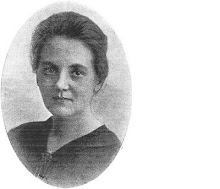
Showing posts with label REV. NIELS BUCH. Show all posts

Tuesday, February 2, 2010

A Wealth of Flowers


Anna Bøg was an avid gardener and there were many admirers of her garden at the women's mission station in Siuyen.

In a 1937 publication, the Young Women's Christian Association wrote that the women's station's "delightful garden with its wealth of flowers is a pleasure and encouragement after long, exhausting work days."

Anna Bøg sent the above picture of her potted lotus plant (center back, with the big pad-like leaves) to her sister Elizabeth in Iowa. The building appears to be the old women missionaries' residence, which dates the picture to sometime prior to 1932. Anna Bøg wrote on the back, "Here you see the lotus flower. The man to the right is the cook and the other man is the gatekeeper." Since a lotus with leaves like this is a Nelumbo, which is an aquatic plant like a water lily, one supposes it must have been growing in a tub of water.

Later, during World War II -- when there was a serious shortage of food -- Anna Bøg grew fruit, vegetables, and grain to help feed herself and the few women she still had in her care. The various foods that she grew were a great blessing since many of the missionaries in other parts of Manchuria developed beri-beri during this period of time for want of vitamin B.

During World War II, the Germans occupied Denmark and Japan occupied Manchuria. D.M.S. had difficulty in getting funds to the missionaries in Manchuria. Rev. Niels Buch, the chairman of D.M.S.'s Manchurian missions, transferred whatever funds could be made available for the few remaining missionaries in Siuyen to Anna Bøg who then disbursed the monies and reported on the disbursements by letter to Rev. Axel Christensen in Dairen, who was the treasurer.

By this time, Anna Bøg was the only remaining missionary at the mission station (both the men's and women's stations), although a missionary physician -- Dr. Marie Nielsen -- and several missionary nurses were still at Siuyen Hospital, which was some distance from the mission station.

In these accounting letters, Anna Bøg included bits of news and often spoke of her garden. Here are some of the comments she made about her gardening in these letters. The sister-in-law of Axel Christensen to whom she refers was Mrs. Helga Christensen:
June 11, 1943 - "Now it is really wonderful summertime here in the mountain valley. We are in the middle of the strawberry season. You can eat them without sugar and we do -- three times a day. In a patch of soil in my garden, I have rye. It is interesting to see how fast it grows. It was sown after Ching-ming, April 5, and now you find ears on the straw. They say, 'It will ripen before the rainy season.' I have also so many beautiful flowers. How summer is a marvelous time."

July 2, 1943 - "Now it is real summer weather, intense heat and rather dry. We had a whole month with strawberries."

August 10, 1943 - "Everything around here is so vigorous it promises to be a good harvest. Our gardens are also luxuriant: All May I had strawberries, July raspberries and blackberries, red currants and black currants, and at present ripe gooseberries and before long the grapes will be ready. I have four sorts. Last year I dried them and had lovely raisins. Many ripe figs are on their way. 'My little garden is like a hothouse,' as your sister-in-law says. Often visitors come to see the flowers."

May 4, 1944 - "Wish you could see how pretty my little yard is full of blooming trees. It is admired by everyone. Now I am both housekeeper and gardener. I had to let my good servant go because the wages raised so high."

June 18, 1944 - "The garden takes all my spare time, but gives me lots of joy, not to speak of all the good things: fruit and vegetables for my table. A lot of my strawberries [were] stolen. Although I am behind a tall wall, they climbed over the wall."

July 28, 1944 - "I am busy weeding my garden, but enjoy the work in the sun and fresh air. My tomatoes are just wonderful."

April 21, 1945 - "I am busy with garden work. To hire a man a day costs 40.00 or more."
The letter of April 21, 1945 was the last accounting letter. A reporter for the Cedar Falls Record who interviewed Anna Bøg in October, 1947, however, wrote about an incident involving Anna Bøg's garden in Siuyen during World War II:
"She spent the long hours in the summer working in her flower and vegetable garden, for she depended on what she could raise to vary her extremely meager rations. She [raised] lovely flowers . . .

"Once she had a particularly beautiful lily blooming on her verandah. One of the Japanese [officials] whom she learned had a particular love for flowers happened around at that time. He sat quietly on her verandah for a long time, and then asked if he might have the lily.

" 'I shall send it to you by my servant,' Miss Madsen told him . . ."
One wonders if the "particularly beautiful lily" was a lotus. In any event, at that time, Anna Bøg was having difficulty keeping the Japanese from commandeering the mission station. She had no servants. Rather, she was doing all the gardening and maintenance work herself, while providing a home for an elderly Bible Woman, Mrs. Kuo, a blind Bible Woman, and a deaf girl. It seems likely that this was a clever maneuver by Anna Bøg to distance this Japanese official and very doubtful that she ever delivered the lily . . .

Sources:
Bøg-Madsen, Anna; letters to Axel Christensen, 1940s, from the D.M.S. archives at the Rigsarkivet (Danish National Archives).
Turnbull, A.B.; "Anna Madsen Survives under [Japanese] Rule, to Return to Manchuria Soon," Cedar Falls Record; October 25,1947; pp. 1, 5. Courtesy of C. Welch.
Young Women's Christian Association, Vest-Øst, 1910-1935, (Kristelig Forening for Unge Kvinder, 1935), p. 64.

Image:
Anna Bøg's lotus flower. Courtesy of C. Welch.

Tuesday, January 12, 2010

Hidden by the Angels (1934-1935)


Anna Bøg's second furlough was from June, 1934, to August, 1935. Anna Bøg traveled by boat from Dairen in Manchuria to Kobe, Japan, and from there by ship to San Francisco for a stay in America. After that she left by ship from New York for Denmark and after some time there departed from Copenhagen by ship for Manchuria.

Unfortunately, this furlough was beset by difficulties -- not in America or Denmark but rather in leaving from and returning to Siuyen. First, turbulent weather threatened to impede her departure. In June, 1934, Rev. Bjergaarde reported:
“Miss Bøg Madsen was . . . scheduled to leave on June 8 by boat from Dairen to Japan and had hoped to leave here by automobile on Thursday, May 31 but this was hindered by an extraordinarily strong rain causing turbulence in the rivers, making it impossible for an automobile to cross without the risk of being pulled into the violent current. There are no bridges. To obtain a military escort and a Chinese cart would not be easy …Someone even thought of telegraphing to get a plane to pick up Miss Bøg Madsen. Well, that’s the way it is when one is at an inland station. It is no problem to travel around the world if one can manage the 90 kilometers to the railroad station. On Monday, June 4, however, the automobile was able to navigate and she caught the ship in Dairen on time.”
During this second furlough in 1934 and 1935, Anna Bøg spent time with her family on the West Coast and in Iowa. Family members remember this visit with affection. For instance, Anna Bøg's brother Peter's son Stanley tells an anecdote about Anna Bøg's visit to the family farm in Oregon. Anna Bøg wanted to go in to the nearest town. Peter offered to drive her but she did not wish to go by automobile and instead insisted on walking. Peter then sent young Stanley to accompany her, whereupon Anna Bøg (then nearly 47 years of age) set off walking at a pace so fast that Stanley was impressed.

After her stays in America and Denmark, Anna Bøg returned to Manchuria in August, 1935 aboard the Italian steamer the Conte Rosso in the company of the Rev. Buch family and other missionaries. The Buchs could go from Dairen by train directly to their post in Harbin but for Anna Bøg her return to Siuyen was even more difficult than her departure had been. Our readers will recall that there was no passenger train to Siuyen, the nearest passenger station being Haicheng. Moreover, there was still a major risk of being attacked or taken hostage by the ever-present bandits. This was especially the case since at the time the tall crops had not yet been fully harvested. As ever, they provided good cover for the bandits. And, the memory of Dr. Nielsen's long captivity was still fresh in everyone's minds.

Here is Anna Bøg's account of her return:
“A month to the day after my departure from Copenhagen, I landed with my fellow passengers in Dairen, where a letter from Siuyen informed me not to attempt the trip to Siuyen until the harvest was over. Three weeks later, a letter arrived saying that the harvest was now advanced to the point where I could try to come. I went to Haicheng, which was the closest railway station to Siuyen. There I was kindly received by the British missionary, Miss Macintyre, and went with her to the authorities. There I was also kindly received and informed that I could travel by an automobile that was leaving the next day from another station. After thinking it over, I concluded that the automobile was for soldiers, and that I had better go by horse and cart even if it was dangerous. In the meantime, I received a message from Siuyen asking me to wait a couple of days because the Bible Woman, Mrs. Kuo, had left for Haicheng in a freight train.

"[On Mrs. Kuo's arrival,] I learned that at times the freight cars had become stuck in the mud. Mrs. Kuo’s freight car had overturned and thrown her into the mire. Mrs. Kuo brought me my old coat and blanket. She dared not suggest that I return with her. I was at a loss about what to do and wondered if it could be God’s will for me to go with her. If things went awry, not only I but also the missionaries in Siuyen could suffer consequences. I continued praying, 'Turn your path to the Lord and he shall rescue you.' The next morning I still had no light but then I read in Job 5: 19-27, 'He shall deliver thee in six troubles: yea, in seven there shall no evil touch thee. … And thou shalt know that thy tabernacle shall be in peace; and thou shalt visit thy habitation …'.

“When I pondered over these words I thought that this was the Lord’s answer to me, and when Mrs. Kuo came to tell me that the train was leaving at 12:00 and she was going with it, the only answer was, 'I will also go.' Mrs. Kuo arranged everything for the trip and had my belongings carefully put away in old sacks, so no one could see what they contained. Then we left with the freight train for Siuyen. My heart was in the beginning uneasy and fearful, especially about the consequences for the D.M.S., but the Word continued sounding, ‘In six anxieties and in seven.’

“The next day, after having been to an inn, the anxiety had disappeared. We passed several villages with me covering my head with my blanket so nobody could see who I was. But all of this would have been of no use if the angels hadn’t hidden me. I sat quietly and enjoyed the trip, seeing the farmers driving the sheaves home to be threshed, and the women gathering cotton in the field or harvesting rice with bowed knives.

“We had several delays, but later I realized that all this was in God’s plan. The village where we stayed overnight the first night was two days later pillaged by 200 bandits. Thirty persons were taken hostage, and several houses burned down. Where we stayed the next night, the neighboring inn had been robbed the same night.

"We came through unharmed and I had one more experience of how the Lord had intervened and brought me home. . .

“… The missionary station is a busy place. The Lord’s rich blessing covers the work and all my dear companions, and with new eyes I see how it is becoming green with growth everywhere; thanks be to God.

"Our old cook, Yang, had for three days been waiting to receive me, and the Chinese said, 'God's Name has been glorified.' . . ."
Sources:
Bjergaarde, Rev. Jens, "Siuyen," Dansk Missionsblad, Vol. 101, Nr. 35, 1934 (exact date unknown), p. 513. Translation by Preben Jørgensen.
Bøg-Madsen, Anna; “Tilbage til Siuyen,” Dansk Missionsblad, Vol. 102, Nr. 49, 1935 (exact date unknown), pp. 759-760.) Translation by Preben Jørgensen.
[This article was condensed by the D.M.S. from personal letters Anna Bøg wrote to friends in Denmark. The D.M.S. changed the language from the first person viewpoint to the third person, i.e. used "she" (hun) rather than "I" (jeg). We have put it back into the first person.]

Image:
Portrait of Anna Bøg taken in Cedar Falls, Iowa, in late 1934 or early 1935. Courtesy of Roger Lais.
All D.M.S. items used with permission.

Tuesday, December 1, 2009

Summer Paradise (Bei-Dai-He and Sorai)


In order to bear the stresses of their missionary labor, it was essential that missionaries to China have a respite in the form of a summer vacation in addition to the furloughs they were required to take every seven years. One of the collateral consequences of the Mukden incident was that the Danish missionaries were unable to spend their summer vacations at their usual location, Bei-Dai-He.

Bei-Dai-He had long been a vacation spot for Protestant missionaries of all denominations, even before Anna Bøg's time. In August, 1913, the Irish Protestant missionary physician, Dr. Isabel Mitchell, wrote, "'It is the last night in this dear little cottage by the sea, and I am all alone. What a lovely holiday it has been! Five weeks without a worry or cloud of any kind, and I have built up a store of health and a whole mansion of happy memories, and if I don’t go back for a good hard happy healthful year’s work after all this, I shall be an ungrateful wretch.'" Mitchell then went on to describe an interdenominational Communion service she attended that last evening, in which Baptists, Methodists, Episcopalians, Presbyterian and Congregationalists (but not Lutherans) all participated.

Although she was only nine years old at the time, Rev. Niels Buch's daughter, Kirsten Berggreen Buch, remembered well as an adult the impact of the Mukden incident, which occurred while she, her family, and other missionaries were on vacation in Bei-Dai-He in 1931. Here are the memories she described to us in her letters:
“…[M]issionary life is not only hard work but also holiday! We had a wonderful place [Bei-Dai-He, meaning] “North of the river”, a long beach, going riding on donkeys or mules to nice places: The Lotus Hills … The owner ran after the donkey. … [W]e galloped away with the owner running breathless after us. I remember I had a peaceful donkey, whereas my brother sat in state on a mule. As soon as we appeared in the summer time the owner came to wish us welcome and then we could just call them. It was customary that I offered a ride to my guests on my birthday –between 8-14 friends.

“But then came the Japanese occupation of Manchuria and [Bei-Dai-He] was taken over by the new rulers. A lot of summerhouses were … taken over by upper class people, military and others.”

“.. . . just 'south of the wall,' Bei-Dai-He [was] near the town called Qin-huan-dao. But during our last stay there in 1931, we got a telegram from our embassy in [Peking], telling us to return to Manchuria immediately. On September 18, the old city [Mukden] … was bombed by Japanese forces. And in the following months, Japan occupied all Manchuria. ('My' town, Harbin, was in the hands of Japanese forces from February 1932). . . . I do remember the last trip home from 'our summer paradise' Bei-Dai-He, quite well. The wagon had several holes from gun-bullets. We traveled in deep darkness during a long night home to Manchuria. In Bei-Dai-He many Danish missionaries had their most wonderful summer experiences. Now it was 'closed land' for 'us Manchurians'?”
In the late 1930s, however, the missionaries found a new location for their much-needed rest and recreation. It was in Korea which, like Manchukuo, was ruled by Japan:
"Another place was found in the late 30’s: Sorai in Korea. A high peninsula was bought by an American missionary, Dr. Underwood (from the Underwood Typewriter Co.) And he then sold parts of the land to all missionaries interested. Most of them were, of course, Americans, but also some of the Danish missionaries bought a piece of land with a little house with a very important veranda. (My father only rented for two years one of the houses from an American missionary on furlough.) Anna and Elise bought a little house.

"We had some wonderful experiences there: Sunday services, 'point-meetings' out at the very point of the peninsula every Wednesday and Sunday evening with a lot of singing from the 'Fellowship Hymn Book' . . . The youngsters from the boarding school in Pyongyang (Am.) played the trombone or horn, and funny anecdotes were given by different people.

"A special thing every time: Mrs. Underwood – or some other lady -- said . . .: 'I have an announcement!' It was usually about a picnic, or a 'clam chowder dinner' down at the beach, etc. The Americans were fantastic with many ideas. For the youngsters there were: 'tennis and swimming competitions' . . . swimming to an island called 'Star-fish' (about 4 km.) Yes, the days at Sorai Beach were full of charm. And the Danish school children gave a show [with] Danish folk-dances, … gymnastics and a little sketch in English … [At] the end of the summer vacation I remember the American youngsters often had to say goodbye to Korea and go for further high school study in [the] USA. At the 'point-meeting' we then all sang the hymn: 'God be with you, till we meet again!' . . . But with World War Two all the American friends disappeared to [the] USA."
Sources:
Buch, Kirsten Berggreen; letters to authors dated August 11,1999, and November 18, 2005. (Parenthetical comments are by Ms. Buch; our edits are in brackets.)
O'Neill, F.W.S. (Ed.); Dr. Isabel Mitchell of Manchuria (James Clarke & Co., London, 1917), pp. 135-136.

Images:
1 - 1908 postcard of Bei-Dai-He (also called Pei-Tai-Ho), from Wikimedia Commons. In the public domain.
2 - Anna Bøg, second row left; Astrid Buch (wife of Rev. Niels Buch); Kirsten and her brother Børge, July 1931
3 - Elise Bahnson, far left; Anna Bøg far right, entertaining the women missionaries at Sorai Beach
4 - Panoramic view of Sorai Beach
Images 2, 3, and 4 courtesy of Kirsten Berggreen Buch.

Tuesday, September 22, 2009

Dr. and Mrs. Niels Nielsen, Medical Missionaries


Dr. Niels Nielsen was the head of the medical mission at Siuyen and the founder and director of Siuyen Hospital. Anna Bøg worked with Dr. Nielsen when she filled in for the head nurse, Anna Busch, when Busch was on furlough in 1923. Also, Anna Bøg continued to work with the Bible women at Siuyen Hospital after she founded the women’s mission station.

Gullach-Jensen’s 1937 book on the Danish missions in Manchuria includes this moving description of Dr. Nielsen’s early life:
“Niels Nielsen was born June 29, 1875 in Hodsager Parish, Yllebjerg Mark, Denmark. His parents were poor small landholders who worked from sunrise to sunset and thus had little time to educate their children. Nevertheless, when Nielsen was still a small boy God made him aware of sin . . . In a dream he saw the savior with a crown of thorns and began to love him . . . He was eager to see the larger world and was overjoyed when he reached six years of age and was sent out to tend cattle. . . .

“At twelve years of age, Nielsen read for the first time the ‘Mission Message’ [apparently a book or periodical]. God called him to bring the Gospel message to the pagans, but how to accomplish that was for him a mystery. He wished to become an ordained minister . . . but becoming a minister would require a lot of money and he did not know how to obtain it. He imagined himself a sailor who would become stranded on a desert island where there were pagans. That way he would have an opportunity to tell them about God. These were his childhood dreams of the future. The day he gave his heart to God, he asked for neither position nor reward, but only for God to place him where he could be of greatest benefit.

“Nielsen began his years of education and they were long and rough. He worked for Pastor Torms in Aulum and confided in him. Torms gave him his initial academic training and prepared him for entry to the Seminariet in Norre Nissum. He did his best but was hampered by his lack of early education. Moreover, so as not to ask for money he restricted himself to bread and water, and this produced mental and bodily depression. He wondered, ‘Am I made for this?’ He asked God for a sign as to whether he should continue or abandon his studies. That same day, he received an invitation from the parsonage to dine there for a month. That sign could not be misunderstood.

“During the summer holidays, he worked at the dam works between Thyborøn and Harboøre to obtain money for his studies in the winter. Besides earning money he was a spiritual adviser for many of the workers. At the same time he developed bonds of friendship with the parish at Harboøre, which meant that during the ensuing years the parish helped him toward his goal of becoming a graduate medical doctor.

"To reach this goal as fast as possible, he decided to go to America. He traveled free of charge as a waiter. Throughout many unusual events, step by step, God paved the way for him. Through the subsequent years he had to work hard as a manual laborer to survive but he progressed in his studies. To his great surprise, one day he found himself on the honor’s list … He went to the head of the school and asked him what the fastest route to the mission field would be. The man replied that a watermelon could grow in three months, but an oak tree -- and whatever has the nature of an oak tree -- needed time to develop. He advised Nielsen that he would require about another ten years of study."
In 1895, Niels Nielsen became engaged to Ane Kirstine Jørgensen.* They met while the future physician was in Viborg for obligatory military service. Ane Kirstine Jørgensen was born on March 1, 1873 in Vinding by Holstebro.

The couple had a long engagement, marrying on September 5, 1902. In 1906, Nielsen obtained his medical degree from the University of Minneapolis. Mrs. Nielsen also received her nurse's training in the United States. Both Dr. and Mrs. Nielsen became American citizens.

In 1907, D.M.S. sent Dr. Nielsen to China, and from 1909 onward he served as a medical missionary at Siuyen. The medical mission included Siuyen Hospital, a polyclinic, and a nursing school where both male and female Chinese were trained as nursing professionals. Dr. Nielsen established the polyclinic in 1909 and the hospital in 1913.

Mrs. Nielsen, who went by her middle name, Kirstine, was an active collaborator with her husband throughout the couple’s years in Siuyen. Along with nurse Anna Busch, Kirstine Nielsen headed the nursing school. During their many years in Siuyen, Anna Bøg and Kirstine Nielsen became good friends.

A major event in Dr. Nielsen’s life was his capture by Manchurian bandits on April 11, 1933. He was held hostage by the brigands more than six months during which time he lost 47 pounds. On October 25, 1933, he was finally released. The Danish author, Kirsten Bergreen Buch, who was born to Rev. and Mrs. Niels Buch in Mukden with Anna Bøg in attendance, and grew up in Manchuria, told us, "I remember one of my classmates, Poul Aagaard Poulsen, rushed into the classroom waving a telegram, 'Dr. Nielsen is free. Dr. Nielsen is free!' By 'classroom' I, of course, mean our tiny room in the Danish boarding school in the town of Antung (Dandong)."

Dr. and Mrs. Nielsen served faithfully in Siuyen until 1940 or 1941 when the Japanese ejected them from Manchuria because they were American citizens. According to the California Death Record, Dr. Nielsen died in Los Angeles on November 4, 1945, at the age of 70. And, according to the same source, Mrs. Nielsen died in Los Angeles on Christmas Day, December 25, 1947, at the age of 74.

Sources:
Buch, Kirsten Berggreen; letter to Preben Jørgensen, March 3, 2005.
Gullach-Jensen, Thyra; D.M.S. i Manchuriet (Copenhagen, 1937), pp. 35-38.

Image:
Dr. and Mrs. Niels Nielsen, from the Danish Missionary Society’s Missionary Album for 1934.
All D.M.S. items used with permission.
-----------
*According to various D.M.S. sources, Ane Kirstine's family name was
Jørgensen. We have been informed, however, that her father was Niels P. Tingsager of Vinding, Holstebro, Denmark.

Friday, May 22, 2009

Using Her Nursing Skills (1923)


Before applying to the Danish Missionary Society, Anna Bøg had taken considerable initiative in preparing herself to serve as a missionary. Among other things, she had on her own obtained nurse’s training at the Norwegian Deaconess Hospital in Chicago.

In a letter to the Danish Missionary Society dated December 11, 1918, Anna Bøg wrote, “I am studying anatomy, nursing, bacteriology, surgery, wound-dressing, operating room, and childbirth. Tonight we had 16 babies. At this hospital they only train deaconesses and missionaries.” (1)

The first information we have about Anna Bøg using her nursing skills in Manchuria was in 1922 when she assisted at the birth of a daughter to missionary parents on July 18, 1922, in Mukden, the capital of the province in which Siuyen is located. The missionary parents were Rev. Niels Buch and his wife, Astrid.*

The Buchs would have traveled to Mukden for the delivery of their baby because at that time they were serving in the southern port city of Dairen [Dalian]. And, they would have traveled entirely by train from the railway station in Dairen. In order for Anna Bøg to reach Mukden, however, she would have first made a two-day journey by cart over treacherous rough roads to reach the nearest train station, which was at Haicheng. Along the way, she would have stayed one or two nights in an inn and slept on a kang. Then, after the cart had finally brought her to the train station, she would have traveled from there another 150 km. by train to Mukden.

The purpose in going to Mukden was so that a missionary physician, Dr. Anton Ellerbek,** could deliver the Buch’s baby. Since 1912, Dr. Ellerbek had been a professor at Mukden Medical College, a teaching center established there by the Scottish Presbyterian missionary, Dr. Dugald Christie. Adjacent to the medical college, there was a medical center

The baby born with Anna Bøg’s help that day was named Kirsten Berggreen Buch. Kirsten would grow up to become the author of several popular books in Danish -- Blue Eyes and Chinese Hearts, The Land of the Black Dragon River, and Everywhere a Storm.

Kirsten Berggreen Buch later said of Anna Bøg, “She ‘received me’ . . . she cared for my mother in her maternity bed -- and she ironed my baby clothes -- even my diapers, said my mother with a smile. Nothing was too good for the little girl . . . ‘Aunt Anna Bøg’, as we missionary children called her, was a wonderful aunt with her American accent.” (2)

After Anna Bøg’s help was no longer needed, she returned to Siuyen. The next year, however, Anna Bøg was called upon to use her nursing skills in Siuyen, at the medical mission, which consisted of a polyclinic established in 1909, and a hospital established in 1913 by Dr. Niels Nielsen.

The head nurse at the medical mission was Anna Busch, *** who began working in Siuyen in 1915. In 1923, Anna Busch went on furlough in accordance with the policy of the Danish Missionary Society that all missionaries should spend a year back home in Denmark after seven years in the field. Therefore Anna Bøg was assigned to the medical mission in Anna Busch’s absence.

It is likely that Anna Bøg’s temporary nursing assignment was very demanding. In her report for 1921, Anna Busch had explained that the hospital had been crippled during the summer months and entirely closed for the remainder of the year because Dr. Nielsen had been on furlough. A doctor had been sent as a temporary replacement during the summer months but his work had been restricted by his limited command of Chinese, and during the remainder of the year there had been no doctor at all.

Even though the hospital had been closed during the fall and winter, the polyclinic had nevertheless continued to operate in both its men’s and women’s departments. A pharmacist had kept the men’s clinic going while Anna Busch had run the women’s clinic with the help of the bible woman Mrs. Kuo and a nursing student. Anna Busch reported that despite the problems, during the year 1921, the polyclinic had served a total of 18,681 patients -- 9,515 men and 9,166 women, and that even in the absence of a doctor they had been able to save several lives. (3)

Although Anna Bøg’s nursing duties must have been quite strenuous during Anna Busch's absence, she would not have been entirely cut off from the mission’s evangelistic efforts because there were evangelistic programs in the hospital to minister to the Chinese patients who were already Christians, to reach out to those who had not yet been evangelized but had come to the medical mission for treatment, and to help those who wished to become literate.

In her 1921 report, Anna Busch wrote, “The evangelistic work in the hospital has substantially been carried out in the same way as the previous year with daily devotions, reading and conversation. All the patients have generally been glad to hear the Gospel and agreeable to learning to read.”

There were also bible women attached to the hospital. Anna Busch reported that during 1921, in addition to their daily evangelistic activities at the hospital, the hospital bible women had made three missionary journeys to outlying areas and had been out on home visits in the immediate area some 191 times, visiting a total of 232 homes.

--------------------------
*Astrid Margrethe Julie Berggreen was born in Copenhagen and came to China in 1918. Rev. Buch was from near Vejle in Jutland and came to China in 1921. The two had married in China the same year Rev. Buch arrived. They served in Manchuria until 1949. Rev. Buch would go on to become the head of the entire Danish Lutheran Mission in Manchuria.

** Dr. Søren Anton Ellerbek was born on August 8, 1872 in Ringkøbing. Dr. Ellerbek served in Manchuria from 1904-1940. Prior to coming to Mukden Medical College, Dr. Ellerbek worked in Antung from 1906-1911 and established a hospital there. Dr. Ellerbek’s first wife, Johanne Graversen, died in China in 1920. In 1922, Dr. Ellerbek married another missionary, Dorthea Toft, who served from 1918-1940.

*** Anna Busch was born on December 24, 1882 in Brovst Parish (Jutland). She served at the medical mission in Siuyen from 1915 to 1946.

Referenced sources:
(1) Bøg Madsen, Anna; letter to Danish Missionary Society dated December 22, 1918, in the Danish Missionary Society archives at the Danish National Archives (Rigsarkivet).
(2) Buch, Kirsten Berggreen; letter to Preben Jørgensen dated May 1, 1997.
(3) Anna Busch, “Siuyen Hopsital. - Frk. A. Buschs Beretning”, Det Danske Missionsselskabs Arsberetning for 1921, pp. 145-147.

Other sources:
Gullach-Jensen, Thyra; D.M.S. in Manchuriet (Copenhagen, 1937).
Jensen, Anne Hviid, I Lys Og Skygge: Dansk Mission i Kina (Unitas Forlag, Copenhagen, 2005).

Images:
Top picture: Staff and bible women at the Siuyen medical mission. Anna Busch, front row center; Anna Bøg Madsen, second row right.
Courtesy of Roger Lais.
Bottom picture: Siuyen Hospital from Det Danske Missionsselskabs Arsberetning for 1921, p. 146.
D.M.S. photograph used with permission.

Thursday, April 23, 2009

The Bible Women


An important aspect of the missionary work of all the Protestant denominations in China was the training and involvement of native evangelists, both male and female. These native evangelists were active not only within the confines of the mission station and its environs but they also traveled to the outlying villages to bring the Gospel there and to encourage those who had converted. The male evangelists were called just that -- evangelists -- while the female evangelists were called "Bible women".

When the Danish Missionary Society sent Anna Bog to Manchuria in 1919, her mission was to take charge of the apostolate to women in Siuyen -- a calling she faithfully lived out until her departure in 1946.

Anna Bog wrote, "My work consisted mainly of education in the mission school, Sunday school, confirmation, catechesis, bible classes, home visits, spiritual support, village work and youth work." (1)

"My main work was to teach the Bible: . . . we covered all 66 books . . . , some of the books more than once. In my work as a Bible teacher I also had the opportunity to teach many, many women to read." (2) *

Rev. Niels Buch had this to say about Anna Bog:

"She worked among the women, preaching, teaching, singing and doing home visits. Among other things, she was singing many Bible words into their minds and she did not shrink from teaching the book of Isaiah. 'It is easy for the women to understand,' she once said at a missionary conference. Some among us had a smile flickering across our faces. Easy? She must have had a gift for making it understandable; maybe she gave them the words and texts that they needed in their daily life." (3)

In the course of this endeavor, Anna Bog worked closely with several Bible women. One was a Mrs. Kuo. Born about 1876, and baptized at age 26, she had been a steadfast Christian ever since. Anna Bog wrote of Mrs. Kuo, "Even during the Boxer Rebellion, she accompanied the missionaries. During the many years she acted as a Bible woman, her sage and good counsel could always be followed." (4)

Another Bible woman with whom Anna Bog worked was Mrs. Fu, the lady on the left in the first picture above. Of Mrs. Fu, Anna Bog said, "She is a lovely woman, both bright and clever. With a great memory, none of the women is as at home with the Bible as Fu. And she is also a prayerful person, an intercessor. There are many, many that she prays for. . . she has found her place and vocation as a good example for the congregation." (5) (The lady on the right in the photograph is Mrs. Chang, widow who had also been a Christian for many years.)

In 1922, Anna Bog participated in a conference for male evangelists and Bible women in Fenghwangcheng (northeast of Siuyen). The second photograph above was taken of those in attendance. Anna Bog is eighth from the left in the back row.

What follows is Anna Bog's account of the conference:

"The earth puts forth produce, first the blade, then the spike, then the corn in full ear."

"Here you see a picture of the entire happy, joyful flock of God's workers here in Manchuria. We were together for the annual evangelists' and Bible women's meeting, which began on September 2 and lasted for three weeks. The first week there was a joint meeting of everyone. Then during the last two weeks there was special instruction for the Bible women. How I have wished that the Danish parishioners could have been there. They would have delighted in seeing God's work being accomplished in each individual heart. It could be read also in their faces they they sought greater knowledge and assistance for their great undertaking, which is for each of us to build Christ's church in this region where in many places the seed has never been sown.

"What came to my mind was the charming metaphor, 'The earth puts forth produce, first blade . . .' Here [in Manchuria] one can see many, many instances of blades sprouting and reaching upward toward the sun, toward God. But these lovable workers reach higher; they are the ear and the fruit of the seed that the Danish church has sown. It can confidently be said of [the Danish faithful] that on the Day of the Lord they will bring a great harvest of China's children, because by their prayers they have perhaps done more than those of us who have the great joy of living as Christians among pagans and bringing them the message of salvation.

"During the first week of our common program, the schedule was as follows:
6:00 a.m. - Reveille
6:30 a.m. - Morning vigil **
7:00 a.m. - Breakfast
7:45 a.m. - Flag-raising, during which we sang the national anthem
8:00 a.m. - Morning devotions, led by Rev. Waidtlow or one of the evangelists
9:00 a.m. - Bible study, during which we assembled in small groups with a leader. Many spoke later of the blessing they received during this hour, which always ended with a brief question and answer period.
10:00 a.m. - Introduction to a discussion that would be continued during the afternoon.
11:00 a.m. - Leaders' meeting, during which the Chinese spoke freely of their views about the meetings, both about the good side and also about what could be changed so that the subsequent sessions would be even better.
3:00 p.m. - We met again and discussed topics from the recent large meeting in Shanghai. The theme of that meeting was 'China for Christ', and it became for our missions, 'Manchuria for Christ'. Each of us received from these discussions a great deal of help to move forward, and these sessions often lasted until 6:00 p.m.
7:00 p.m. - There was another meeting of a different kind, such as a question period, slides, choral practice, and the like.
9:00 p.m. - Lights out. It was delightful to go around from one kang [heated brick bed] to another to say goodnight to the Bible women. It was a blessing for them to be together for three weeks. Many of them work in very lonely and remote places and often have difficulties, but when they get together with the others every year at such good meetings with such good fellowship and are able to speak to each other about the work, they feel strengthened and encouraged. Often during the meetings we were reminded to 'bear one another's burdens' and to make the effort so that the Gospel will be proclaimed throughout our entire district and to help the Christians read the Bible.

"The amiable young Rev. Yen was to all a great blessing. He was both warm and sincere in all that he did. Old Rev. Yen*** was also a great blessing as were all of the evangelists that led the meetings. Hou and Wang from Port Arthur played the violin for us every day.

"The last Sunday there was a solemn Communion service. Evangelist Hou spoke about Christian love and old Rev. Yen served at the altar. The same evening there was the leave-taking. It was sad to part after our lovely time together.

"Young Rev. Yen called the workers from one station after another up to the front so that we could be really clear about where they belonged and could better pray for them.

"When old Rev. Yen rode out of the yard in the last cart, he said his farewell in both Danish and English as well as Chinese.

"Then came the two weeks of training for the Bible women, where every hour of the day was filled with the pleasure of being together. There were hours spent in Bible study of the book of the prophet Zechariah, 1st Peter, and Christ's Passion; outline exercises, geography, accounting, hygiene, singing, and games. And, in addition, there were discussion sessions, question and answer sessions, etc.

"The Bible women from Siuyen and I later attended meetings in both Antung and Takushan during which the local women who had remained at home were informed about the meeting in Fenghwangcheng.

"At the conclusion of the meeting, a prayer list was formulated. Some of the friends of D.M.S. may also wish to join. We pray for both the work and the workers, that they might be filled with the Holy Ghost.

"Monday - Port Arthur and Petune
Tuesday - Dalny and Harbin
Wednesday - Takushan and Sweihwafu
Thursday - Siuyen and Kwantien
Friday - Fenghwangcheng and Huanyen
Saturday - Antung and Chinchow"
(6)

Two years later, in 1924, a permanent school for the Bible women was founded in Fenghwangchang about which more will be said in the future.

--------------------
*In 1927, Anna Bog told an Iowa newspaper reporter that illiteracy was the "curse of China" and that 9 out of 10 Chinese could neither read nor write their own names. (Cedar Falls Daily Record, 1927, exact date of clipping not known.)
** It is not clear whether the "morning vigil" consisted of individual mental prayer or a communal matins. At another time, Anna Bog wrote of community evening prayer. It is interesting to learn of these vestigial Catholic practices (Liturgy of the Hours) by Danish Lutheran missionaries and converts in China.
***Yen Hsing-chi (referred to here as "Old Reverend Yen") was the first Chinese minister ordained by the D.M.S. in Manchuria. He was ordained November 23, 1913. His nephew Yen-Baoding ("Young Reverend Yen") was ordained in 1922.

Referenced sources:
(1) Olsgaard, Susanne (Danmission), letter to Preben Jorgensen dated February 27, 1997.
(2) Bog Madsen, Anna; "The Old Missionary's Brief Story", Nazareth Lutheran Messenger; Spring, 1971.
(3) Buch, Rev. Niels; Dansk Missionsblad; Vol. unknown, Nr. unknown; March 3, 1973.
(4) Bog Madsen, Anna; letter in D.M.S. files at the Danish National Archives dated December 5, 1946.
(5) Bog Madsen, Anna; "To Guldkristne", Dansk Missionsblad, Vol. 97, Nr. 10, March 5, 1930, pp. 145-146.
(6) Bog Madsen, Anna; "Fra Evangelist og Bibelkvindemodet i Fenghwangcheng"; Dansk Missionsblad, Vol. 89?, Nr. 49, December 27, 1922, pp. 654-657.
Translations from the Danish of (1)(3) and (4) by Preben Jorgensen
Translation of (5) by Betty Christensen
Translation of (6) by Marie-Jacqueline

Other sources:
Jensen, Anne Hviid; I Lys og Skygge (Unitas Forlag, Copenhagen, 2005), p.110. (Information regarding the ordinations of the two Rev. Yens.)

Images:
Photograph of Mrs. Fu and Mrs. Chang from the 1930 article
Photograph of the evangelists' and Bible women's conference from the 1922 article

D.M.S. articles and photographs used with permission