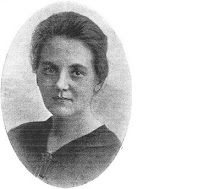
Showing posts with label DR. MARIE NIELSEN. Show all posts

Tuesday, May 11, 2010

The Death of Helga Johansen (October, 1944)


As we mentioned in our post about Dr. Marie Nielsen, there was a typhoid outbreak in Manchuria in 1944 and the Japanese required Siuyen Hospital to admit typhoid patients from a nearby forced-labor camp despite the risk to the other patients and hospital staff. Dr. Marie, head nurse Anna Busch, and nurse Helga Johansen all contracted the disease. Dr. Marie and Anna Busch survived. Sadly, Helga Johansen did not.

In her 1937 book on the D.M.S. missions in Manchuria, Gullach-Jensen wrote this entry about Helga Johansen, who was a brand-new missionary at that time:
"During her childhood and youth, she heard about God and respected him, but only about the age of 19 did she learn to know Jesus Christ as her Savior, and shortly after that she realized that her future work should be in the missionary field.

"With this as her goal, she started training to be a nurse. After finishing her training at Skive Hospital, Miss Johansen addressed herself to D.M.S. with a request to be sent out as a missionary, but at that time it was not possible.

"During the wait, Miss Johansen worked as a community nurse and as a trainee at 'Marthabo' and finally she went to a Bible school in Glasgow. In October 1936, D.M.S. sent her to Manchuria. After a short stay in our mission field, she went to the language school in Peking, from where she sent her first letter to the Dansk Missionsblad (Bl. 1937, pages 176-177).

"The intention is that Miss Johansen shall start working shortly, first at the missionary hospital in Suihuafu and thereafter in Siuyen."
In her first letter home to the D.M.S., written in 1937 while she was in language school in Peking, Helga Johansen wrote about Chinese Christian art. We began our post on that topic with her discussion. In the same letter, she spoke about her early experiences in China and her growing love for the Chinese people:
"In this my first greeting from China, I want to send a heartfelt thanks both to the D.M.S. Board and to the Friends all over the country. Thank you for sending me out as your envoy. These first months have been rich in experiences and encouragements. It was a great pleasure to be received and welcomed by the Danish missionaries in Manchuria. The first three weeks I stayed with Miss [Karen] Gormsen. But greatest thing of all is being permitted to discover how God's love towards this country and its people grew in my heart and thus confirmed me in my missionary vocation.

"Language study is very interesting. It is like going on a voyage of discovery trying to find out what those mysterious signs and squiggles mean. It requires hard work, but it also brings joy when what first seems hopeless and unintelligible gradually becomes clear. We are about 150 language students, of which about 80 live at the school; 15 nations are represented. I am the only one from Denmark."
She continued the letter with her discussion of Chinese Christian art which we already posted, and then signed the letter, "Affectionate greetings, Your joyful envoy, Helga Johansen."

Anna Bøg's accounting letter to Axel Christensen of October 25, 1944, contained the following entry about the death of this enthusiastic and "joyful envoy" after only seven years of missionary service:
"You probably have heard that H. Johansen died October 16, at 2:00 p.m. Mr. and Mrs. Willer* came in the 20th, and she was buried on Sunday the 22nd. A very beautiful funeral. First a Danish service in her room, then a Chinese service in the Hospital yard. All the nurses, men and girls, carried her to the cemetery, her casket covered with Dannebrog [the Danish flag], and all the nurses clad in white . . . In the evening, we had a Danish Communion. . . ."
Sources:
Bøg-Madsen, Anna; accounting letter to Axel Christensen; October 25, 1944, from the D.M.S. archives in the Rigsarkivet. Courtesy of Kirsten Berggreen Buch. Original in English.
Gullach-Jensen, Thyra; D.M.S. i Manchuriet (D.M.S., Copenhagen, 1937), pp. 125-126. Translated by Preben Jørgensen.
Johansen, Helga; "En Hilsen fra Peking," Dansk Missionsblad; Vol. 104, Nr. 12, 1937 (exact date unknown); pp. 176-177. Translated by Preben Jørgensen
All D.M.S. items used with permission.

Image:
Photograph of Helga Johansen from the Dansk Missionsblad; Vol. 110, Nr. 44, November 26, 1943, p. 626
---------------------
*"Mr. and Mrs. Willer" - This refers to Rev. and Mrs. Ludvig Willer. Rev. Willer was born on October 7, 1900. He was the son of the pastor in Aulum. He obtained his theology degree in 1924, was the secretary for K.F.U.M. in Horsens until 1927, then a pastor until 1933. D.M.S. sent him to Manchuria in 1934. He was based in Dairen. (Jensen, D.M.S. i Manchuriet, pp. 22-23.)

Monday, April 26, 2010

Part I - Seven Years of Solitude (1939-1946)


Throughout the war years, Anna Bøg remained at the women's mission station in Siuyen. Due to the restrictions by the Japanese, however, her ability carry out her work was limited.

Many years later, Anna Bøg wrote about the war years:
"My dear co-worker (Elise Bahnson, the architect) was detained in Denmark for 6-7 years. I was so glad and grateful to God that He let me stay in China with the Christians. Those war years were difficult years; the uncertainty of it all, will it be life or death, made us live from day to day and never knowing what might happen next! We were severely rationed in everything; we never saw a happy face; we never heard good news; all connections with our Home Board and loved ones were cut! . . . Through those dark and difficult years I read my Bible from beginning to end every year."
When Anna Bøg was in Cedar Falls, Iowa, in October, 1947, she was interviewed by a journalist who wrote:
"Those seven years, without a radio or outside news of the world she knew and loved, were lonely, yes, they were full of possible danger. . . .

"A tall woman . . . [she] seems to have the same strength in her body that is evidenced in the calm lines of her face . . . Some of that strength and peace she seems to radiate when you talk to her she must surely have gained in those seven solitary years in Manchuria.

"When the war broke out and the Japanese tightened up on Manchuria, only six white women were left in the Danish mission. Usually when the mission was being operated at full strength, there were 12 white persons there, six men and six women. But the men were caught home on long earned furloughs and were not permitted to return during the war.

"In an area which contained her mission, a large station, with 300 children in the school, and from which the men and women worked for a radius of about 30 miles, she was lefta Japanese paper, no one of her own to talk to.

"'I read my Bible,' she said, 'and then I knit and taught the Chinese in the village who dared to come to see me, how to knit. I knit through many winters, garments to keep the Chinese warm. They had sheep, and would spin the yarn from this wool.[']

"Once the Japanese officials on one of their visits asked her, 'How do you think the war will go?'

"Since she had only Japanese newspapers to read at that time, she said, 'According to your newspapers, [you] will win the war.'

"Rationing in Manchuria was in three classes, and she was in the third or lowest with the Chinese. She got 24 pounds of field corn a month, often this was mouldy, and the Chinese women would grind it with a mill stone there. Sometimes they would receive a kind of Chinese grain,*** salt, matches, and they had two pounds of soy bean oil per year, their only fat. The Danish people were often allowed some flour each month, a pound of sugar at first, later two ounces each month and finally none at all."
There was a break in Anna Bøg's solitude in August, 1943, when a letter from Elise Bahnson in Denmark got through. On August 4, 1943, Anna Bøg wrote the following letter in reply:
"Thank you for your letter of 7 April, received August 1. It was almost two years since I last heard from you. The last letter was dated 15-9-41. My last letter to you was from Sorai in '41.
"It was a great joy to hear from you. I am fine. I've lived alone since you left. We Danes get together often. Almost every day Gudrun (Budtz), Dagmar (Petersen) and I come together for a quiet moment. Dagmar Petersen was a patient at the hospital for five months. Now she is well again. There are currently six at the hospital.**** We have it blessed and good together.

"I still have Chang En Hsi, the only workman here in both stations. Since New Year's, Pastor Shun has been No. 2 minister in Antung. Hung (Yü Ch'ing from Siuyen) came here, but he has not yet received his Hsü-ke (preaching license) so he does not work. We have not had Communion since New Year. The old co-workers are still here. Li (Yung Te, an evangelist) preaches on Sundays.

"The self-support by the congregation is going excellently. It is harder with the administration because they lack a leader.

"Chao Lai Chen (the blind Bible Woman) is in Mukden on vacation. When she comes back, she will have to knit, as she has not obtained her Hsü-ke. I haven't either. I don't go out, only to the hospital. I have read so many good books, and am helping in the garden and house.

"The banker (Wang, who was Sunday School Superintendent) was relocated far away. Since then his wife died and he married her sister.

"I have not seen Mrs. Bolwig since '41. She would like to visit me, but has not succeeded.

"Please greet all the dear friends."
As we mentioned previously in our post A Wealth of Flowers, beginning in early 1943, Anna Bøg was put in charge of disbursing money transferred to her by Rev. Buch, the head of the Manchurian missions, and she wrote accounting letters to the treasurer, Axel Christensen, who was based in Dairen. Here are some excerpts from the letters Anna Bøg wrote to Axel Christensen during 1943 that were not included in the earlier post:
February 15, 1943

"I have received your letter concerning a sum to be paid to Dr. M.N. [Marie Nielsen]. She is presently a patient at Antung Hospital and there is no hurry for the installation of lights. I have received the rest of the money for the timber in Chienshanyao, 48.38, and placed it in the transfer account, where there is now a balance of 87.29. We have the Reverend Ting from the capital here for one week's meetings for the Christians. He brought fresh greetings from our friends there. Frimer is presently learning to play the piano. Dr. Marie has undergone a major operation."
March 8, 1943
"I have received from Buch a draft of 2,000. And today received your letter of March 5. After paying the three of us, the balance in the transfer account is 1,597.66. I have difficulties these days. A new group of soldiers arrived and they are always short of accommodations. They come here and want to live here in the Bible Women’s house. It is one of the larger. Otherwise we feel rather well. We are missing the doctor, being in the hospital, but it is important she recovers her strength before returning to work.

"Hearty greetings to you, your family and Miss H. Madsen [Helen Madsen]."

March 25, 1943

"Your two letters of March 12 and March 22 arrived. I have an account in the bank here. Central Bank of Manchou. So it shall be okay to send by 'telegraphic transfer'. To receive the last draft from Buch I had to procure a pass to have it transferred. Dr. Marie is again back in full activity. Now we are awaiting Dagmar Petersen who is on sick leave. Your sister-in-law [Helga Christensen] has been unwell for some time, but she is courageous. It is difficult for me to keep the empty men's station. The soldiers are after the houses there. They moved into a room in the street chapel."

June 11, 1943

"Thank you for the money forwarded. After payment to the different persons, the balance in the transfer account as of June 6 is 830.44.

July 2, 1943

"I received your telegram and letter concerning the transfer of the 2,000. It is okay with the bank. The balance today is then 2,830.44. I suffered a couple of small thefts this week. First, my wallet with about $30.00. Two days later my watch and dark glasses. A boy of 16 was the offender. The watch and the empty wallet came back. He was not from our town. Six years ago he and his family moved up North. He was here to visit his elderly grandmother. They caught him.

"Now it is real summer weather, strong heat and rather dry."

August 10, 1943

"I have received your letter of August 5 and have paid the sum to H. Johansen [Helga Johansen].

"The cash balance is now 1,627.95. We are all well. In the hospital, they have been busy all summer."
There are no available letters from Anna Bøg to Axel Christensen between mid-August and mid-December, 1943.

On October 14, 1943, the Royal Danish Consulate in Harbin wrote to the Shanghai Delegation of the International Red Cross Agency for Prisoners of War, informing the Shanghai Delegation that the American Red Cross was inquiring on behalf of Anna Bøg's sister, Marie Petersen, residing at 703 West Tenth Street, in Cedar Falls, Iowa.

The letter from the Danish Consulate states:
"The American Red Cross Washington asked us to secure news concerning the whereabouts and welfare of: Madsen, Anna B. of Danish Nationality born May 13th, 1888, Profession: Missionary teacher. Last known address: Danish Mission, Siuyen, Manchoukuo, Japan. It is thought that Aksel CHRISTENSEN, Danish Mission, Dairen, P.O. Box 73, Manchuriet, would be able to give information regarding Miss Madsen’s welfare."
As we will learn in next week's post, the reason for the break in the letters was that during the autumn Anna Bøg was hospitalized for several weeks with a high fever. In mid-December 1943, however, Anna Bøg’s letters to Axel Christensen resume:
December 15, 1943
"May I ask you to be kind enough to pay Joh. Witt [Johannes Witt], Mukden, the 15.00 I owe him. . . .

"I wish you and your family Merry Christmas and a good New Year! May it be the last wartime Christmas. We are all well here in the mountain city. Consider that your sister-in-law has now been here for more than two years and she feels well out here in the countryside."
To be continued . . .

Sources:
Bøg-Madsen, Anna; "The Old Missionary's Brief Story," Nazareth Lutheran Messenger (Cedar Falls, Iowa; 1971) Courtesy of Casey Welch.
Bøg-Madsen, Anna; letters to Axel Christensen, 1940s, and letter from the Danish Consulate, from the D.M.S. archives at the Rigsarkivet (Danish National Archives). Courtesy of Kirsten Berggreen Buch. (illet or sorghum.
****"Six at the hospital - See above for the names of five. We believe the sixth was Mrs. Helga Christensen, the sister-in-law of Axel Christensen. She was not a missionary but had come to China temporarily and then been unable to leave due to the onset of the war. We think she then spent some time as a nurse at Siuyen Hospital.

Image:
The blind Bible Woman, Chao-Lai-Chen (left) with an unknown girl, from Dansk Missionsblad, Vol. 111, Nr. 10, March 10, 1944; p. 138.

Tuesday, April 20, 2010

Dr. Marie Nielsen Takes Charge of Siuyen Hospital (Early 1941)


As a result of the forced departure from Siuyen of Dr. and Mrs. Niels Nielsen in 1941, Dr. Marie Nielsen was transferred from Antung (now Dandong) to Siuyen to take charge of the mission hospital. We will refer to her as "Dr. Marie", since that is how the missionaries referred to her, and doing so helps distinguish her from Dr. Niels Nielsen.

Karen Marie Nielsen was born April 29, 1894. According to D.M.S. publications, she was born in Nidløse. According to a secondary source, she was born in the village of Stenlille near Skuerup, which is on Zealand, the same Danish island on which Copenhagen is located.

According to the secondary source, Marie's parents were Kristen Nielsen, a farmer, and Mathilde Michaelsen, who were involved in the Indre Mission movement, a pietistic Lutheran sect founded in Stenlille in 1861. The secondary source says Marie grew up in Holbæk, which is also on Zealand.

At the age of 18, Marie felt called to be a missionary. In 1919, she graduated from Haslev High School -- the same folk high school from which Anna Bøg had graduated ten years earlier. In 1927, Marie obtained her medical degree at the University of Copenhagen after which she spent a short time in Scotland and England.

In November, 1927, the D.M.S. sent Dr. Marie to Manchuria. She traveled to China by ship together with Anna Bøg during the latter's return from her 1926-1927 fundraising furlough.

By 1932, a separate women’s hospital was completed at Antung and Dr. Marie was put in charge, overseeing a Chinese doctor (Dr. Pi) and a Danish nurse (Andrea Nielsen).

From May 1934 until August 1935, Dr. Marie was in Denmark on home leave (furlough), then returned to Antung.

After her 1941 transfer to Siuyen, Dr. Marie labored there throughout the remainder of the Japanese occupation and Second World War.

In 1944, there was a typhoid outbreak. The Japanese required Siuyen hospital to treat typhoid patients from a nearby forced-labor camp, in spite of the danger to the ordinary patients. Both patients and staff caught the disease, which spread throughout the hospital. Dr. Marie was in charge of the disinfections as well as the medical care. The conditions were desperate because of inadequate food and drug supplies. Dr. Marie contracted the disease but survived.

After the end of World War II, no replacement for Dr. Marie could be found, so she remained in Siuyen. In 1945 the Russians came into Manchuria and a year later the Chinese communists. The communists burdened Siuyen Hospital by filling it with patients from the army. Dr. Marie worked seven days a week under increasingly chaotic conditions.

In 1947, Dr. Marie was able to return to the hospital in Antung where she remained, despite harassment by the communists, until 1951. The communists demanded free treatment, used the hospital as a base for political indoctrination, maligned and harassed the missionaries, and even imprisoned several of them.

After returning to Denmark in 1951, Dr. Marie left again in 1952 for Tanzania where she served in two mission hospitals. She contracted malaria, returned to Denmark in 1959, and died in Copenhagen on September 19, 1968.

Primary sources:
D.M.S. Missionary Album
Gullach-Jensen, Thyra; D.M.S. i Manchuriet; (D.M.S., Copenhagen, 1937), pp. 62-65.

Secondary source:
Nielsen, Estrid; "Marie Nielsen", Dansk Kvindebiografisk Leksikon (online). (Additional commentary about Dr. Marie is available at the linked website.)

Image:
Photograph of Dr. Marie Nielsen from one of the D.M.S. missionary albums, courtesy of Kirsten Berggreen Buch.
All D.M.S. items used with permission.

Tuesday, April 13, 2010

Farewell to the Nielsens (Early 1941)


Even prior to Japan's attack on Pearl Harbor on December 7, 1941, hostilities between the United States and Japan were such that the missionaries who were American citizens had to leave Manchuria. This included Dr. and Mrs. Niels Nielsen who, though Danish-born, had become Americans.

In a letter to the D.M.S. dated February 17, 1941, that was published in the missionary newspaper in April, 1941, Anna Bøg wrote of the Nielsen's departure:
"After 32 years of service, Dr. and Mrs. Nielsen are breaking away from D.M.S.'s Mission Hospital in Siuyen. It is not easy to have one's roots pulled up after working and living in one place for so many years.

"When the local people speak of Dr. Nielsen, they call him, 'Merciful doctor'. Or they say, 'He has saved countless human lives.' Or, 'He practiced true charity.'

"How sad it is to see the old pioneers break away. They belong with the place and people.

"It was typical of Dr. and Mrs. Nielsen that they continued their work until the day before their departure. They have always been diligent and took good care of the hospital. They helped each other and supported each other. Their home has always been harmonious.

"At the congregation's farewell party, many good and warm words were said to them by representatives of the congregation council, the congregation, and the co-workers [evangelists and Bible Women]. When there was an opportunity for anyone to speak, women and men stood up and thanked Dr. and Mrs. Nielsen for what they had been to them.

"We will long remember Dr. Nielsen's farewell speech: 'A farmer took all his savings to purchase wheat and sowed his field. And then came Winter and laid his icy hand and a thick layer of snow over the field. The farmer was about to lose heart and was afraid that all was lost. But one early spring day, his little son came running and said, "Father! The field is full of green sprouts!"'

"In 1939, we took leave of Miss Bahnson; in 1940, of Dr. and Mrs. Asschenfeldt; and now Dr. and Mrs. Nielsen. And there is no one yet to fill all the empty places. Of the relatively strong missionary staff we have always had here in Siuyen, we are now only three single women."*
Source:
Bøg-Madsen, Anna; "Afsked med Siuyen," Dansk Missionsblad, Vol. 108, Nr. 15, April 11, 1941; pp. 196-197.

Image:
Dr. and Mrs. Nielsen on Manchurian cart. From the Nielsen estate, courtesy of Mike from Monterey.
--------------------------
*When Anna Bog said, "We are now only three single woman", the other two must have been Dr. Marie Nielsen and Nurse Anna Busch at Siuyen Hospital. Next week's post will be about Dr. Marie Nielsen, who took charge of Siuyen Hospital when the Nielsens left.

Tuesday, February 2, 2010

A Wealth of Flowers


Anna Bøg was an avid gardener and there were many admirers of her garden at the women's mission station in Siuyen.

In a 1937 publication, the Young Women's Christian Association wrote that the women's station's "delightful garden with its wealth of flowers is a pleasure and encouragement after long, exhausting work days."

Anna Bøg sent the above picture of her potted lotus plant (center back, with the big pad-like leaves) to her sister Elizabeth in Iowa. The building appears to be the old women missionaries' residence, which dates the picture to sometime prior to 1932. Anna Bøg wrote on the back, "Here you see the lotus flower. The man to the right is the cook and the other man is the gatekeeper." Since a lotus with leaves like this is a Nelumbo, which is an aquatic plant like a water lily, one supposes it must have been growing in a tub of water.

Later, during World War II -- when there was a serious shortage of food -- Anna Bøg grew fruit, vegetables, and grain to help feed herself and the few women she still had in her care. The various foods that she grew were a great blessing since many of the missionaries in other parts of Manchuria developed beri-beri during this period of time for want of vitamin B.

During World War II, the Germans occupied Denmark and Japan occupied Manchuria. D.M.S. had difficulty in getting funds to the missionaries in Manchuria. Rev. Niels Buch, the chairman of D.M.S.'s Manchurian missions, transferred whatever funds could be made available for the few remaining missionaries in Siuyen to Anna Bøg who then disbursed the monies and reported on the disbursements by letter to Rev. Axel Christensen in Dairen, who was the treasurer.

By this time, Anna Bøg was the only remaining missionary at the mission station (both the men's and women's stations), although a missionary physician -- Dr. Marie Nielsen -- and several missionary nurses were still at Siuyen Hospital, which was some distance from the mission station.

In these accounting letters, Anna Bøg included bits of news and often spoke of her garden. Here are some of the comments she made about her gardening in these letters. The sister-in-law of Axel Christensen to whom she refers was Mrs. Helga Christensen:
June 11, 1943 - "Now it is really wonderful summertime here in the mountain valley. We are in the middle of the strawberry season. You can eat them without sugar and we do -- three times a day. In a patch of soil in my garden, I have rye. It is interesting to see how fast it grows. It was sown after Ching-ming, April 5, and now you find ears on the straw. They say, 'It will ripen before the rainy season.' I have also so many beautiful flowers. How summer is a marvelous time."

July 2, 1943 - "Now it is real summer weather, intense heat and rather dry. We had a whole month with strawberries."

August 10, 1943 - "Everything around here is so vigorous it promises to be a good harvest. Our gardens are also luxuriant: All May I had strawberries, July raspberries and blackberries, red currants and black currants, and at present ripe gooseberries and before long the grapes will be ready. I have four sorts. Last year I dried them and had lovely raisins. Many ripe figs are on their way. 'My little garden is like a hothouse,' as your sister-in-law says. Often visitors come to see the flowers."

May 4, 1944 - "Wish you could see how pretty my little yard is full of blooming trees. It is admired by everyone. Now I am both housekeeper and gardener. I had to let my good servant go because the wages raised so high."

June 18, 1944 - "The garden takes all my spare time, but gives me lots of joy, not to speak of all the good things: fruit and vegetables for my table. A lot of my strawberries [were] stolen. Although I am behind a tall wall, they climbed over the wall."

July 28, 1944 - "I am busy weeding my garden, but enjoy the work in the sun and fresh air. My tomatoes are just wonderful."

April 21, 1945 - "I am busy with garden work. To hire a man a day costs 40.00 or more."
The letter of April 21, 1945 was the last accounting letter. A reporter for the Cedar Falls Record who interviewed Anna Bøg in October, 1947, however, wrote about an incident involving Anna Bøg's garden in Siuyen during World War II:
"She spent the long hours in the summer working in her flower and vegetable garden, for she depended on what she could raise to vary her extremely meager rations. She [raised] lovely flowers . . .

"Once she had a particularly beautiful lily blooming on her verandah. One of the Japanese [officials] whom she learned had a particular love for flowers happened around at that time. He sat quietly on her verandah for a long time, and then asked if he might have the lily.

" 'I shall send it to you by my servant,' Miss Madsen told him . . ."
One wonders if the "particularly beautiful lily" was a lotus. In any event, at that time, Anna Bøg was having difficulty keeping the Japanese from commandeering the mission station. She had no servants. Rather, she was doing all the gardening and maintenance work herself, while providing a home for an elderly Bible Woman, Mrs. Kuo, a blind Bible Woman, and a deaf girl. It seems likely that this was a clever maneuver by Anna Bøg to distance this Japanese official and very doubtful that she ever delivered the lily . . .

Sources:
Bøg-Madsen, Anna; letters to Axel Christensen, 1940s, from the D.M.S. archives at the Rigsarkivet (Danish National Archives).
Turnbull, A.B.; "Anna Madsen Survives under [Japanese] Rule, to Return to Manchuria Soon," Cedar Falls Record; October 25,1947; pp. 1, 5. Courtesy of C. Welch.
Young Women's Christian Association, Vest-Øst, 1910-1935, (Kristelig Forening for Unge Kvinder, 1935), p. 64.

Image:
Anna Bøg's lotus flower. Courtesy of C. Welch.

Saturday, June 13, 2009

A Fundraising Furlough (1926-1927)


Anna Bøg conducted her American fundraising tour from October, 1926, to May, 1927. During this effort, Anna Bøg addressed audiences at churches, schools, and civic organizations in various locations including Cedar Falls, Iowa; and Los Angeles, California. She used visual aids to bring home to her listeners the reality of life in the mission field. Aside from raising funds to build the women’s mission station, Anna Bøg endeavored to inspire young people to become missionaries. She impressed many who met her as a woman of remarkable strength, dedication and self-discipline.

Three articles from the Cedar Falls newspaper describe so well the flavor of Anna Bøg’s 1926-1927 presentations, that we quote them here at length.

One, about Anna Bøg’s presentation at a local public school, is entitled “Missionary From China Gives Talk At Miner School”:
"Miss Anna Madsen, a teacher in a mission school of northern [sic] Manchuria, who is visiting here at the home of her brother, C.B. Madsen, 319 Grant street, while in the United States on a furlough, gave an interesting and instructive talk on the life of the Chinese before the pupils of the Miner school yesterday afternoon. Miss Madsen illustrated her talk in various ways. She had dolls cleverly dressed to illustrate the costumes of the different types of Chinese people. Victoria Madsen, a pupil at Lincoln school and a niece of Miss Madsen, gave a demonstration of eating with chopsticks. Miss Madsen and her niece also sang several Chinese songs. Beautiful pieces of Chinese embroidery were shown, and Chinese writing was illustrated on the blackboard, by Miss Madsen." (1)
A second newspaper article, which describes Anna Bøg’s presentation to the Cedar Falls Rotary Club, was entitled, “Word Picture of China Given to Rotarians”.
"The best way to understand the Chinese people is to study their early leaders in philosophy, according to Miss Anna Madsen, missionary to China who has just returned to spend a year with relatives in Cedar Falls. Miss Madsen spoke this noon before the members of the Rotary club. She has spent the past seven years in China and reads and speaks the language of China.

"China is a nation that is suffering from arrested development, according to Miss Madsen, although 3,000 years ago it had reached a high degree of civilization. Since the Russian-Japanese war, it has had an awakening, the missionary said, but out of every ten of population nine are illiterate. This accounts for the country’s present backwardness, the speaker said. This illiteracy was termed the curse of China by Miss Madsen, who said that nine out of ten can neither read nor write their own names.

"The missionary described her first trip into the interior of China, where she was obliged to travel 60 miles in a cart over treacherously rough roads. She found the people curious and so inquisitive that they crowded around her table at inns asking all sort of personal questions, all of which she answered with patience and politeness. Miss Madsen described the Chinese people as having wonderful power of control over their feelings, never becoming impatient.

"Most Chinese homes are built of clay with beamed ceilings. Paper is used in doors and windows instead of glass. All the heat for the home comes from the kitchen, where the family meal is cooked in one large kettle. The kettle sends heat under the brick beds along the sides of the main room of the house. The older people in the home eat their meals first, while the younger people stand by with patience awaiting their turns and serving their elders. The respect of the young people for their elders is beautiful to see, according to Miss Madsen.

"Although a law was passed in China prohibiting women and girls from binding their feet, there are more who do it than who don’t, said the missionary. She showed a little red fancy shoe about five inches long that had been worn by a Chinese woman 30 years of age. The former owner of the shoe had become Christianized and gave the shoe to the missionary for a souvenir. Miss Madsen also exhibited other specimens of Chinese handiwork and read passages from the writings of Confucius to show the type of thinking of the Chinese philosopher. She also produced a miniature idol and said that trinkets of many kinds can be had at cut prices in Chinese shops, but that dealers will never give a cut price on an idol.” (2)
A third article describes her talk to the local high school Y.W.C.A.:
“[Anna Bøg] told the girls how different the Chinese are from Americans, doing everything contrary to our customs. She said that there are only about six missionaries to every 300,000 Chinese people. Miss Madsen described the way in which the poorer people live -- in houses of one room with brick walls, brick floors and paper windows. They sleep on brick beds. She said that the girls do not go to school but sit at home and sew. She showed many curious things, displaying what the Chinese girls wear on different occasion[s], and exhibiting many pieces of embroidery. The majority of the people still retain the custom which forbids a girl to see her husband before they are married. She concluded her talk by saying she hoped some of the Y.W.C.A. girls here would someday become missionaries, as it is one of the greatest services that one could perform in order to show love for Jesus Christ." (3)
On May 27, 1927, Anna Bøg arrived in Copenhagen after concluding her American tour and wrote a letter of thanks to the American friends of the D.M.S. that was published in the missionary newspaper in early June, 1927:
"With the receipt in this amount for money for the new women’s station in Siuyen, I would also like to send everyone a loving greeting from D.M.S., where I arrived a week ago, and a warm thanks for all the money and for the abundant affection I received. Thinking back on my journey over there brings many wonderful memories. I felt at home in the congregations and miss them. I hope that we can maintain the relationship between China and America, since you will now be part of the new station that is to be a small part of D.M.S.’s great work in China. I am sure that they too will take pleasure in what you gave. We still have much to do to construct the buildings; but ‘From above, God has helped.’

"Upon my arrival in Denmark, I attended the large Sanctification Meeting* at Nyborn Beach; we were about 800 participants. It was a blessing to be allowed to sit still and take in. I am waiting till November to travel back to China." (4)
Although Anna Bøg remained in Denmark from the end of May until early November, 1927, she did not “'sit still and take in'” for very long. Instead she continued her efforts. In mid-November 1927, D.M.S. wrote the following on Anna Bøg’s return to China:
"On Wednesday, 9 November, a group left for China comprised of Miss Bøg Madsen; [Dr.] Marie Nielsen; Miss Chiang from China, and a nurse, Miss Busch, who is traveling on her own behalf to spend a year with her sister at the hospital in Siuyen. . . . Miss Bøg Madsen spent part of her home stay in America, where many of her relatives live, and held a number of meetings there. Also here in this country she has been fervent in going about and advocating China’s cause. She is returning to her old work in Siuyen and longs fervently to construct the much-needed new building dedicated to the work with women and a residence for the women missionaries. In America, she collected 5,017.93 kroner for that purpose. Given the current oppressive economic situation,** it is not settled whether we can give her additional support for the work." (5)
------------------------------------
* A “sanctification meeting” is a phenomenon of the Holiness-Pentecostal movement, not the Lutheran Church. It is said that at the time in question these meetings were quite sedate.
** Denmark and Norway suffered a severe economic contraction during the years 1925–27 that some attribute to matters related to the gold standard. The period is sometimes referred to as the “gold-parity depression”.

Referenced sources:
(1) “Missionary From China Gives Talk At Miner School”, Cedar Falls Record; unknown date in 1926 or 1927. Courtesy of Casey Welch.
(2) “Word Picture of China Given to Rotarians”; Cedar Falls Record; unknown date in 1926 or 1927. Courtesy of Casey Welch.
(3) “High School Y.W.C.A. Elects Officers for the Next School Year”, Cedar Falls Record; unknown date in 1926 or 1927. Courtesy of Casey Welch.
(4) Bøg Madsen, Anna; “Den nye Kvindestation i Siuyen”; Dansk Missionsblad, Vol??, Nr. 23, June 8, 1927, pp. 362-353.
(5) “Ti China”, Dansk Missionsblad, Vol.??, Nr. 47, November 23, 1927, p. 732.
All D.M.S. material used with permission.

Image:
Anna Bøg aboard ship, probably during her 1926-1927 fundraising furlough. Courtesy of Casey Welch.