Showing posts with label MANCHURIAN CARTS. Show all posts

Tuesday, April 13, 2010

Farewell to the Nielsens (Early 1941)


Even prior to Japan's attack on Pearl Harbor on December 7, 1941, hostilities between the United States and Japan were such that the missionaries who were American citizens had to leave Manchuria. This included Dr. and Mrs. Niels Nielsen who, though Danish-born, had become Americans.

In a letter to the D.M.S. dated February 17, 1941, that was published in the missionary newspaper in April, 1941, Anna Bøg wrote of the Nielsen's departure:
"After 32 years of service, Dr. and Mrs. Nielsen are breaking away from D.M.S.'s Mission Hospital in Siuyen. It is not easy to have one's roots pulled up after working and living in one place for so many years.

"When the local people speak of Dr. Nielsen, they call him, 'Merciful doctor'. Or they say, 'He has saved countless human lives.' Or, 'He practiced true charity.'

"How sad it is to see the old pioneers break away. They belong with the place and people.

"It was typical of Dr. and Mrs. Nielsen that they continued their work until the day before their departure. They have always been diligent and took good care of the hospital. They helped each other and supported each other. Their home has always been harmonious.

"At the congregation's farewell party, many good and warm words were said to them by representatives of the congregation council, the congregation, and the co-workers [evangelists and Bible Women]. When there was an opportunity for anyone to speak, women and men stood up and thanked Dr. and Mrs. Nielsen for what they had been to them.

"We will long remember Dr. Nielsen's farewell speech: 'A farmer took all his savings to purchase wheat and sowed his field. And then came Winter and laid his icy hand and a thick layer of snow over the field. The farmer was about to lose heart and was afraid that all was lost. But one early spring day, his little son came running and said, "Father! The field is full of green sprouts!"'

"In 1939, we took leave of Miss Bahnson; in 1940, of Dr. and Mrs. Asschenfeldt; and now Dr. and Mrs. Nielsen. And there is no one yet to fill all the empty places. Of the relatively strong missionary staff we have always had here in Siuyen, we are now only three single women."*
Source:
Bøg-Madsen, Anna; "Afsked med Siuyen," Dansk Missionsblad, Vol. 108, Nr. 15, April 11, 1941; pp. 196-197.

Image:
Dr. and Mrs. Nielsen on Manchurian cart. From the Nielsen estate, courtesy of Mike from Monterey.
--------------------------
*When Anna Bog said, "We are now only three single woman", the other two must have been Dr. Marie Nielsen and Nurse Anna Busch at Siuyen Hospital. Next week's post will be about Dr. Marie Nielsen, who took charge of Siuyen Hospital when the Nielsens left.

Monday, March 1, 2010

Bookseller Hsü and Chang Wen Ch'ing (Early 1937)


In early 1937, the D.M.S. missionary newspaper published a vignette by Anna Bøg about Bookseller Hsü, an itinerant salesman who sold separate books of the Bible in the countryside around Siuyen. Our readers might remember that Elise Bahnson introduced Mr. Hsü in one of the articles excerpted in our post Difficulties to Overcome (1931-1932).

In the early 1937 newspaper, there was also a vignette by Elise Bahnson about Mrs. Chang, an elderly Chinese woman who had recently been baptized, and Elise Bahnson reported that, thanks to the new motor coach line, Rev. and Mrs. Bolwig had been able to travel to Siuyen from the town where they lived in order to spend Christmas with the missionaries and Chinese congregation. The Bolwigs had many friends among the Chinese Christians in Siuyen.

Here are the two vignettes:
Bookseller Hsü

"Bookseller Hsü has just returned from a trip of a little over two months during which he sold 4,700 individual books of the Bible. Not all homes could pay with cash, but they were willing to trade a bowl of corn for a little book.

"To the question, 'Are you sure they will now read in the books?', he replied, 'I find some parts that I know they would like to read and mark them, because if they begin with Jesus' genealogy they might easily stop there.'

"He had spent a week in the home of a schoolteacher who has previously been a patient at the hospital [in Siuyen]. Food was not so difficult to come by in the country dwellings, but a couple of times it was 1 o'clock in the morning before he found his night's lodging.

"He experienced many answered prayers, spoke with many about God's Word, and witnessed [to them]. If there were sick people in the home, he talked with them and prayed for them. . . .

"On such a trip, one cannot escape a chance encounter with a troop of brethren who live in the mountains [bandits]. But, despite the winter cold, snow, and many other difficulties, the bookseller returned fresh, happy, and empty-handed, having left behind the many books."
Chang Wen Ch'ing

"A truth-seeking soul, eagerly she had served Buddha and other gods for many years. She had abstained from meat with the intention of honoring the gods.

"Now 75 years old, she came with her daughter to the worship service during the month of October, the first Sunday Reverend Cheng was here. During the entire week [of women's meetings] she sat in the first pew, listening. She had reached her destination; she had finally found the truth.

"She lived here in those days, and started to eat meat again, an important sign that she had begun to break away from idols to serve the living God. She was full of questions. Even though she was advanced in age and she could not learn to read, she could go home and do away with all the idols. We told her about Christmas and invited her to come back.

"She came at the appointed time, worn out and motion-sick from riding on the rigid cart. During Christmas, she lived here again in order to be with us as much as possible, and her hope was fulfilled: the Sunday between Christmas and New Years, she was baptized 'Chang Wen Ch'ing'.

"For three weeks, she lived with her daughter and came for further instruction. Now she is back home in the country."
Source:
Bøg-Madsen, Anna; "Smaabreve fra Siuyen - Bogsælgeren," and Bahnson, Elise; "Smaabreve fra Siuyen - Gamle Fru Chang"; Dansk Missionsblad, Vol. 104, No. 9; 1937 (exact date unknown); pp. 127-129. Translation by Marie-Jacqueline.

Image:
Photograph of Mrs. Chang (front), Bible Woman Miss P'ei, and Anna Bøg, from the article cited above.
All D.M.S. items used with permission.

Tuesday, January 12, 2010

Hidden by the Angels (1934-1935)


Anna Bøg's second furlough was from June, 1934, to August, 1935. Anna Bøg traveled by boat from Dairen in Manchuria to Kobe, Japan, and from there by ship to San Francisco for a stay in America. After that she left by ship from New York for Denmark and after some time there departed from Copenhagen by ship for Manchuria.

Unfortunately, this furlough was beset by difficulties -- not in America or Denmark but rather in leaving from and returning to Siuyen. First, turbulent weather threatened to impede her departure. In June, 1934, Rev. Bjergaarde reported:
“Miss Bøg Madsen was . . . scheduled to leave on June 8 by boat from Dairen to Japan and had hoped to leave here by automobile on Thursday, May 31 but this was hindered by an extraordinarily strong rain causing turbulence in the rivers, making it impossible for an automobile to cross without the risk of being pulled into the violent current. There are no bridges. To obtain a military escort and a Chinese cart would not be easy …Someone even thought of telegraphing to get a plane to pick up Miss Bøg Madsen. Well, that’s the way it is when one is at an inland station. It is no problem to travel around the world if one can manage the 90 kilometers to the railroad station. On Monday, June 4, however, the automobile was able to navigate and she caught the ship in Dairen on time.”
During this second furlough in 1934 and 1935, Anna Bøg spent time with her family on the West Coast and in Iowa. Family members remember this visit with affection. For instance, Anna Bøg's brother Peter's son Stanley tells an anecdote about Anna Bøg's visit to the family farm in Oregon. Anna Bøg wanted to go in to the nearest town. Peter offered to drive her but she did not wish to go by automobile and instead insisted on walking. Peter then sent young Stanley to accompany her, whereupon Anna Bøg (then nearly 47 years of age) set off walking at a pace so fast that Stanley was impressed.

After her stays in America and Denmark, Anna Bøg returned to Manchuria in August, 1935 aboard the Italian steamer the Conte Rosso in the company of the Rev. Buch family and other missionaries. The Buchs could go from Dairen by train directly to their post in Harbin but for Anna Bøg her return to Siuyen was even more difficult than her departure had been. Our readers will recall that there was no passenger train to Siuyen, the nearest passenger station being Haicheng. Moreover, there was still a major risk of being attacked or taken hostage by the ever-present bandits. This was especially the case since at the time the tall crops had not yet been fully harvested. As ever, they provided good cover for the bandits. And, the memory of Dr. Nielsen's long captivity was still fresh in everyone's minds.

Here is Anna Bøg's account of her return:
“A month to the day after my departure from Copenhagen, I landed with my fellow passengers in Dairen, where a letter from Siuyen informed me not to attempt the trip to Siuyen until the harvest was over. Three weeks later, a letter arrived saying that the harvest was now advanced to the point where I could try to come. I went to Haicheng, which was the closest railway station to Siuyen. There I was kindly received by the British missionary, Miss Macintyre, and went with her to the authorities. There I was also kindly received and informed that I could travel by an automobile that was leaving the next day from another station. After thinking it over, I concluded that the automobile was for soldiers, and that I had better go by horse and cart even if it was dangerous. In the meantime, I received a message from Siuyen asking me to wait a couple of days because the Bible Woman, Mrs. Kuo, had left for Haicheng in a freight train.

"[On Mrs. Kuo's arrival,] I learned that at times the freight cars had become stuck in the mud. Mrs. Kuo’s freight car had overturned and thrown her into the mire. Mrs. Kuo brought me my old coat and blanket. She dared not suggest that I return with her. I was at a loss about what to do and wondered if it could be God’s will for me to go with her. If things went awry, not only I but also the missionaries in Siuyen could suffer consequences. I continued praying, 'Turn your path to the Lord and he shall rescue you.' The next morning I still had no light but then I read in Job 5: 19-27, 'He shall deliver thee in six troubles: yea, in seven there shall no evil touch thee. … And thou shalt know that thy tabernacle shall be in peace; and thou shalt visit thy habitation …'.

“When I pondered over these words I thought that this was the Lord’s answer to me, and when Mrs. Kuo came to tell me that the train was leaving at 12:00 and she was going with it, the only answer was, 'I will also go.' Mrs. Kuo arranged everything for the trip and had my belongings carefully put away in old sacks, so no one could see what they contained. Then we left with the freight train for Siuyen. My heart was in the beginning uneasy and fearful, especially about the consequences for the D.M.S., but the Word continued sounding, ‘In six anxieties and in seven.’

“The next day, after having been to an inn, the anxiety had disappeared. We passed several villages with me covering my head with my blanket so nobody could see who I was. But all of this would have been of no use if the angels hadn’t hidden me. I sat quietly and enjoyed the trip, seeing the farmers driving the sheaves home to be threshed, and the women gathering cotton in the field or harvesting rice with bowed knives.

“We had several delays, but later I realized that all this was in God’s plan. The village where we stayed overnight the first night was two days later pillaged by 200 bandits. Thirty persons were taken hostage, and several houses burned down. Where we stayed the next night, the neighboring inn had been robbed the same night.

"We came through unharmed and I had one more experience of how the Lord had intervened and brought me home. . .

“… The missionary station is a busy place. The Lord’s rich blessing covers the work and all my dear companions, and with new eyes I see how it is becoming green with growth everywhere; thanks be to God.

"Our old cook, Yang, had for three days been waiting to receive me, and the Chinese said, 'God's Name has been glorified.' . . ."
Sources:
Bjergaarde, Rev. Jens, "Siuyen," Dansk Missionsblad, Vol. 101, Nr. 35, 1934 (exact date unknown), p. 513. Translation by Preben Jørgensen.
Bøg-Madsen, Anna; “Tilbage til Siuyen,” Dansk Missionsblad, Vol. 102, Nr. 49, 1935 (exact date unknown), pp. 759-760.) Translation by Preben Jørgensen.
[This article was condensed by the D.M.S. from personal letters Anna Bøg wrote to friends in Denmark. The D.M.S. changed the language from the first person viewpoint to the third person, i.e. used "she" (hun) rather than "I" (jeg). We have put it back into the first person.]

Image:
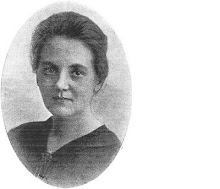
Portrait of Anna Bøg taken in Cedar Falls, Iowa, in late 1934 or early 1935. Courtesy of Roger Lais.
All D.M.S. items used with permission.
Monday, April 6, 2009

Manchurian Rafts, Carts -- and Bicycles


A significant feature of Manchurian life in the 1920s and throughout the time Anna Bog served in Siuyen was the river raft. Such rafts were employed especially for the timber to be used in building construction. The logs would be gathered on the banks of small rivers and floated to a collection point where they waited for spring. Then, during springtime, the logs were bound onto very large rafts and floated down the Yalu River to Antung.

Yosano, a Japanese poetess who traveled up the Yalu from Antung on a steam launch in the spring of 1928, wrote, "It was still too early for the high season of floating rafts, though we were able to spot a few of them here and there . . . these rafts enveloped the clouds at the peaks on the river, each one rising far and above the next. Reflecting the green of reeds and willows, they glistened brightly, and as they leisurely sailed down the river they evoked the happy appearance of ridding themselves of modern machine civilization. From time to time, tattered clouds came and went and a light rain fell . . . "

Another significant feature of Machurian life was the mule- or horse-drawn cart, which was the common mode of transportation. The cartwheels were made of hard wood and the cart was quite sturdy but extremely uncomfortable.

In 1888, James wrote in The Long White Mountain, "The cart has no springs and no seat inside. Natives spread bedding on the floor and squat on that, but the shaking is simply agonizing." James solved the problem by putting a cushion on the shaft and sitting next to the driver -- something that was considered improper.

In the early 1900s, the Irish missionary physician, Isabel Mitchell, found the lack of springs so unbearable that she often walked alongside the cart, leaving her belongings to toss and shift about inside.

Anna Bog, however, had a different solution -- the bicycle. It was not at all unusual even at that time for a girl or woman to travel by bicycle in Anna Bog's native Denmark, but it was unheard of in Siuyen.

Anna Bog relates:

"As the years went on young well-trained Bible women were the result of the work we carried on here. As I was also the first woman in our town to ride a bicycle I made it a point to teach all these young Bible women to ride a bicycle, which caused quite a sensation in town. By and by we were 12 who rode bicycles together with the native pastor, all the [male] evangelists and the Bible colporteur."

Referenced sources:

Bog Madsen, "The Old Missionary's Brief Story", Nazareth Lutheran Messenger (Cedar Falls, Iowa; 1971) Courtesy of Casey Welch.

James, The Long White Mountain or a Journey in Manchuria [1888], First Greenwood Reprinting (New York, 1968)

O'Neill, Dr. Isabel Mitchell of Manchuria (London, 1917)

Yosano, Travels in Manchuria and Mongolia [1928], translated by Joshua A. Fogel (New York, 2001)

The image above, from Dr. Mitchell's biography, shows a typical Manchurian cart and driver, along with the tall dense kaoliang through which so many roads ran.

Monday, March 30, 2009

Assignment in Manchuria


We continue here the story of Anna Bog Madsen as she took up her assignment at the small town of Siuyen in Manchuria where she served as a missionary from 1920 continuously until 1946. Siuyen is about 250 km. northeast of Port Arthur and 180 km. south of Mukden [Shenyang]. It lies between a wooded mountain range and the 2 km. Tajang River.

The image above is a sketch map of Manchuria in 1937 published by the Danish Missionary Society. It refers to Manchuria as "Manchuokuo" because by 1937 the Japanese had taken over Manchuria. The long lines of alternating black and white mark the railroads. Siuyen is found north of Takushan and west of Antung.

Although Siuyen is now called Xuiyan and Manchuria is now called Dong Bei, we refer to these and other Manchurian place names by those in use during Anna Bog's tenure, sometimes providing in brackets the current usage.

In later describing the early days of her missionary labor, Anna Bog wrote:

"The three northern provinces in China were not as over-populated as the southern provinces are; but it is a rich country with very fertile soil. There are also mines here and there. Not far from us, where we live, is a silver mine. The people are quite well situated. Far up in the old walled city of Siuyen, a two-days ride from the nearest railway station, and across mountain passes, rivers, plains, and through many villages, in an old walled-in Mission Compound is where I was stationed. Here you found only Chinese houses. Pioneer missionaries had labored for 20 years already. There was a small congregation here, a Boy's and Girl's School, a Hospital, a Street Chapel, and there were some dear Christians here.

"I started to teach English in the Boys' High School and in the Girls' Normal School. I made many good contacts here. Some of them lasted as long as I was in the field. As a second year language student (Chinese) I started itinerating with a native Bible woman [trained catechist] visiting the out-stations served from Siuyen. One of these stations was a two-day cart ride away. This was real evangelistic work. As I was the first foreign woman they had ever seen, it was quite easy to gather big crowds. My Moody [Bible Institute] lessons on 'How to do personal work' were really put into practice. All my years in the service of the Lord I have loved to do this type of work."

For further context regarding Manchuria at that time, we provide here a summary:

Manchuria is bordered by Mongolia to the west, Russia to the north and northeast, and Korea to the southeast. To the southwest are Beijing and the Great Wall. To the south is the Yellow Sea and beyond it the province of Shantung [Shandong].

Manchuria is divided into three provinces: Heilongjiang, Kirin [Jilin], and Fengtian [Liaoning]. Heilongjiang is the northernmost of the three. One of its principal cities is Harbin. Kirin is the middle province. One of its major cities is Chang Chun. Fengtian is the southernmost province. Its capital is Mukden [Shenyang]. Fengtian province includes the Liaodong Peninsula, near the tip of which lies the port city of Dairen [Dalian] and the ice-free port of Port Arthur. Another important city is Antung [Dandong], a gateway to Korea. The 790 km. long Yalu River marks the border between Manchuria and Korea. Siuyen is in Fengtian province.

Manchuria has many lovely mountains and the woods teamed with bears, wild boars, hares, wolves, foxes, and wild cats. There is abundant fish in the sea to the south. Manchuria is rich in coal, gold, iron, and precious stones, including jade.

Agriculturally, Manchuria has been called the garden of China. The principal crops include cereal grasses (sorghum or millet, "kaoliang" in Chinese), tobacco, corn, cotton, and fruit. Every old book on Manchuria mentions the kaoliang, which grew up to 12 feet high, blocking the view from the road or train. In the 1920s, most of the buildings in Manchuria were thatched half-timbered buildings with mud walls. Most towns had only 10,000 to 15,000 inhabitants and were walled.

The native occupants of Manchuria were the Manchus, a mongoloid people. In 1644, the Manchus invaded China, established a dynasty (the Qing dynasty) and ruled China for nearly 300 years. The Qing rulers prohibited development of Manchuria and also prohibited immigration into Manchuria of Han Chinese -- that is, Chinese not of Mongol, Manchu, Tibetan, or other non-Chinese extraction.

In 1911, Sun Yat-sen and the Chinese Nationalist Party (Kuomintang) overthrew the Qing rulers. This opened Manchuria to immigration from other parts of China. After the overthrow, there was continuous political struggle in China, including conflicts between rival warlords and civil war between the Communists and the Kuomintang.

By the time of Anna Bog's arrival in 1920, Manchuria was ethnically heterogenous (comprised of Han Chinese, Manchus, Russians, Japanese, and Koreans). At least eighty percent of the population was Han Chinese. After settlement was permitted, many of the immigrants came from Shantung.

A significant feature of Manchurian life in the 1920s was the South Manchuria Railway. It was begun by the Russians who, in the late 1890s, had negotiated an agreement with China to bring the Trans-Siberian Railroad across Manchuria to Port Arthur at the southern tip of Manchuria.

The Russians obtained a long-term lease of the Liaotung peninsula where Port Arthur is located and built a line between Chang Chun and Port Arthur. In 1904, however, the Japanese attacked the Russians (Russo-Japanese War) and as a result Japan acquired the railroad and related leases in 1905. The Japanese then constructed a line connecting Mukden and Antung, built towns, made harbor improvements, mined for coal and iron, developed utilities, and conducted agricultural experiments.

Thus, by the time Anna Bog arrived in the 1920s, there were large numbers of Japanese nationals. Moreover, the Russians had founded the city of Harbin in northern Manchuria in 1900 as a railway center. And, after the Japanese took over the South Manchuria Railway in 1905, the Russians had retained the northern portion of the railway. So, by 1920, Harbin had a large Russian population. Residents included many White Russians who had fled the Russian Revolution and the establishment of the Soviet Union in 1917.

Referenced sources:

Anna Bog Madsen, "The Old Missionary's Brief Story"; The Messenger; Nazareth Lutheran Church; Cedar Falls, Iowa; 1971. Courtesy of Casey Welch.

Thyra Gullach-Jensen, "Sketch Map of Manchuria"; D.M.S. i Manchuriet, Danish Missionary Society; Cophenhagen, 1937. Used with permission.